

Ever stopped to wonder how many weeks in a year there really are? It sounds simple, but the answer can vary depending on whether you’re talking about a regular year, leap year, payroll planning, or calendar systems. Most people say 52 weeks—and they’re mostly right—but there’s a little more to it than that.
In this guide, we’ll break it all down in a clear and practical way. Whether you need the answer for budgeting, scheduling, salary planning, or simple curiosity, you’ll find everything you need here.
How Many Weeks in a Year?
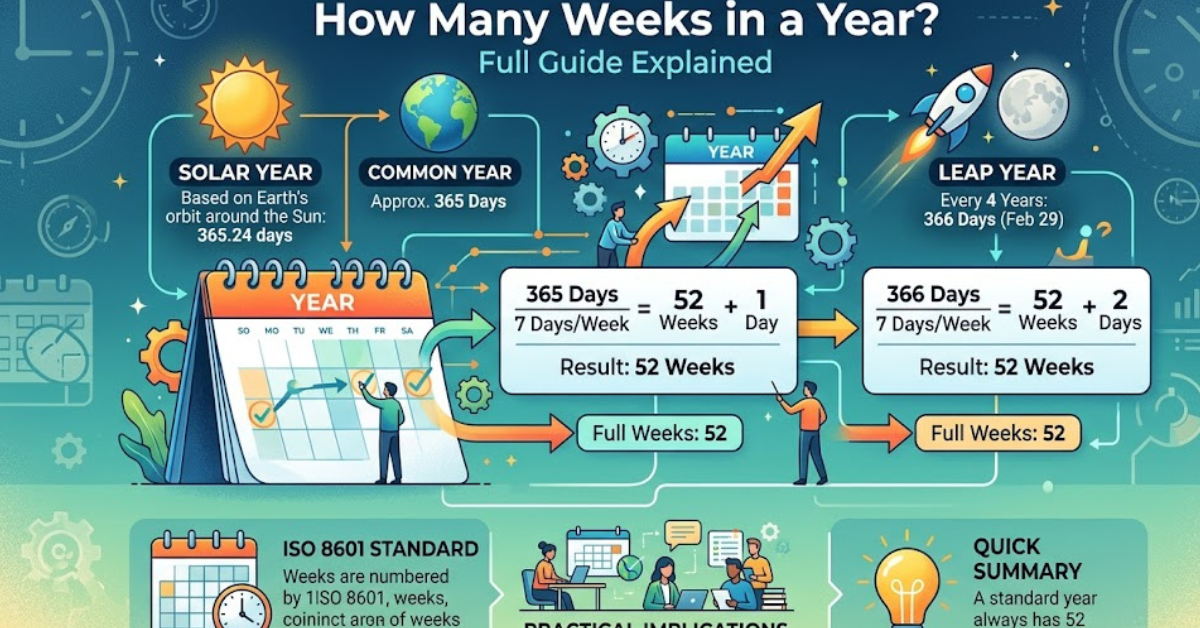
A standard year has 365 days. Since one week contains 7 days, divide 365 by 7:
365 ÷ 7 = 52 weeks and 1 day
So, a normal year contains:
- 52 full weeks
- 1 extra day
That’s why calendars shift slightly each year.
Quick Answer
- Regular year = 52 weeks + 1 day
- Leap year = 52 weeks + 2 days
How Many Weeks in a Leap Year?
A leap year has 366 days instead of 365. This happens every four years (with some century exceptions).
Calculation:
366 ÷ 7 = 52 weeks and 2 days
So, leap years have:
- 52 full weeks
- 2 extra days
This matters when calculating schedules, annual work hours, and date planning.
How Many Weeks in a Year 2024?
The year 2024 was a leap year, meaning it had 366 days.
That equals:
- 52 weeks and 2 days
So if you searched how many weeks in a year 2024, the correct answer is 52 full weeks plus 2 extra days.
How Many Weeks in a Year 2025?
The year 2025 is a regular year with 365 days.
That means:
- 52 weeks and 1 day
So for anyone asking how many weeks in a year 2025, the answer is 52 weeks plus 1 extra day.
How Many Weeks in a Year 2026?
The year 2026 is also a standard year.
That gives us:
- 52 weeks and 1 day
If you’re checking calendars or planning ahead, 2026 has 52 weeks and 1 day.
Why Do We Say 52 Weeks in a Year?
Most people round to 52 weeks because it’s the number of complete seven-day periods in one year.
Since:
- 52 × 7 = 364 days
There is always at least 1 extra day left over in a normal year.
That extra day is why the same date falls on a different weekday each year.
How Many Weeks in a Year for Payroll?
Payroll schedules often use weeks instead of months.
Weekly Payroll
- 52 pay periods in most years
Biweekly Payroll
Employees paid every two weeks usually receive:
- 26 paychecks per year
Because:
- 52 weeks ÷ 2 = 26
In some calendar setups, an extra pay period may occasionally occur depending on pay dates.
Semimonthly Payroll
- 24 pay periods annually
(Not based on weeks)
How Many Weeks in a Year for Biweekly Payroll?
For companies running biweekly payroll:
- One paycheck every 2 weeks
- 26 pay periods in a typical year
This is one of the most common payroll systems because it is simple and predictable.
How Many Weeks in a Year for Salary Calculation?
Many employers calculate hourly annual income using 52 weeks.
Formula:
Hourly Rate × Hours Per Week × 52
Example:
- $20/hour
- 40 hours/week
Annual salary:
20 × 40 × 52 = $41,600
This is why understanding weekly totals is useful for job offers and budgeting.
Weeks in a Year Without Weekends?
If weekends are removed, we count only weekdays.
A normal year has:
- 365 days
- 104 weekend days (52 Saturdays + 52 Sundays)
That leaves:
- 261 weekdays in many standard years
Convert to workweeks:
261 ÷ 5 = about 52.2 workweeks
So the number depends on holidays and leap years.
Weeks in a Year and a Half?
One and a half years equals:
- 52 × 1.5 = 78 weeks
More accurately, depending on leap years, it may be slightly more.
Weeks in a Year Divided by 2?
If you divide a year into two equal week sections:
- 52 weeks ÷ 2 = 26 weeks
So half a year is roughly 26 weeks.
How Many Weeks in a Year Left?
To know how many weeks remain in the current year, subtract today’s date from December 31 and divide remaining days by 7.
This changes daily, but it’s useful for:
- Goal tracking
- Fitness plans
- Savings targets
- Business deadlines
Simple Weeks in a Year Calculator
Use this formula:
Days in year ÷ 7 = Weeks
Examples:
- 365 ÷ 7 = 52 weeks + 1 day
- 366 ÷ 7 = 52 weeks + 2 days
Weeks in a Year at a Glance
| Year Type | Days | Weeks | Extra Days |
| Standard Year | 365 | 52 | 1 |
| Leap Year | 366 | 52 | 2 |
Common Uses for Week Calculations
People search this topic for many reasons:
- Payroll planning
- Pregnancy tracking
- Fitness programs
- Academic calendars
- Budgeting goals
- Project deadlines
Read also <<< How to Change a Tire Safely: Step-by-Step Guide
FAQs
Is a year exactly 52 weeks?
No. A standard year is 52 weeks and 1 day, while a leap year is 52 weeks and 2 days.
How many weeks are in 2026?
2024 had 52 weeks and 2 days because it was a leap year.
How many weeks are in 2026?
2025 has 52 weeks and 1 day.
How many biweekly pay periods are in a year?
Most years have 26 biweekly pay periods.
How many work weeks are in a year?
Usually around 52 workweeks, depending on holidays and vacation days.
Why do calendars change weekdays every year?
Because a year is not an even number of weeks. Extra days shift the starting weekday.
Conclusion
So, How many weeks in a year? The simplest answer is 52 weeks, but the complete answer is 52 weeks and 1 day in a regular year or 52 weeks and 2 days in a leap year. That small difference matters for calendars, payroll, salary calculations, and long-term planning.
Now that you know the math behind it, you can plan your year smarter—whether for finances, work, or personal goals.