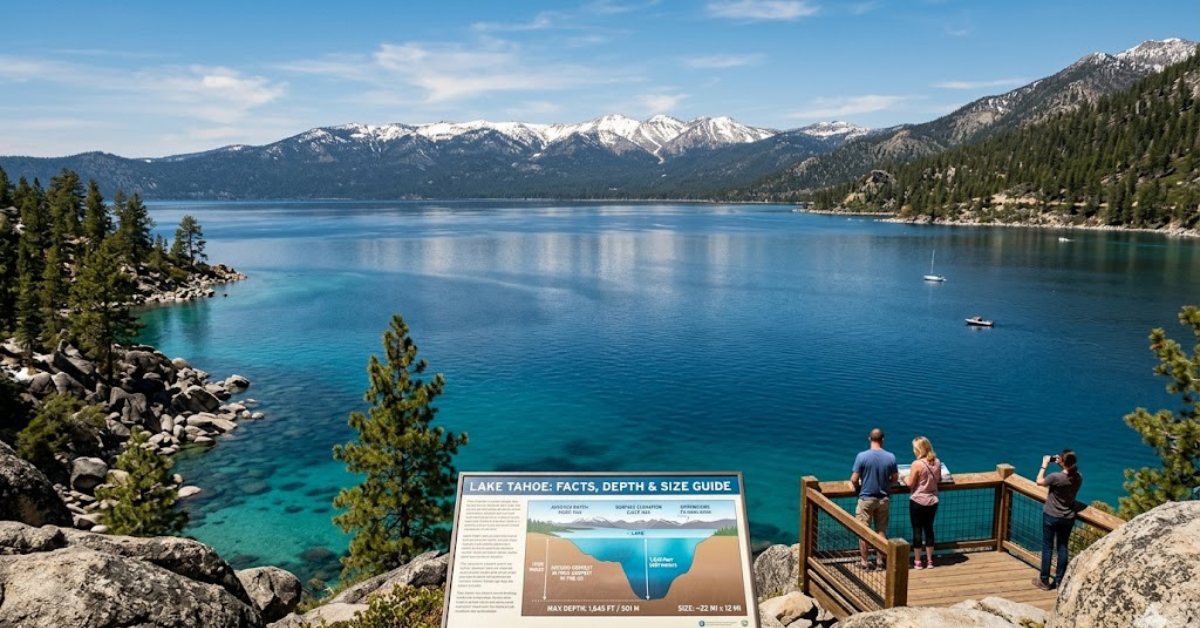

Lake Tahoe is famous for its crystal-clear water, mountain scenery, and incredible depth. Located on the border of California and Nevada, this alpine lake attracts millions of visitors every year. But one question continues to spark curiosity: how deep is Lake Tahoe?
The answer is impressive. Lake Tahoe reaches a maximum depth of 1,645 feet (501 meters), making it the second-deepest lake in the United States after Crater Lake in Oregon. Its enormous depth, combined with exceptionally clear water, gives the lake its stunning blue appearance and mysterious underwater beauty.
In this guide, you’ll learn everything about Lake Tahoe’s depth, how it compares to other lakes, why it’s so deep, and what makes this natural wonder unique.
How Deep Is Lake Tahoe in Feet?
Lake Tahoe is 1,645 feet deep at its deepest point. That’s nearly one-third of a mile straight down into cold, clear water.
To put this into perspective:
- The lake is deeper than the height of many skyscrapers
- You could stack more than four Eiffel Towers underwater and still not reach the surface
- Its depth is enough to completely submerge some of the world’s tallest buildings
The average depth of the lake is around 1,000 feet, which is still extremely deep compared to most freshwater lakes in North America.
How Deep Is Lake Tahoe in Meters?
For those using the metric system, Lake Tahoe’s deepest point measures approximately 501 meters.
That depth places it among the deepest lakes in the world. While it doesn’t rank near ancient lakes like Russia’s Lake Baikal, it is still considered one of the most significant alpine lakes globally because of its size and clarity.
How Deep Is Lake Tahoe in Miles?
People often ask how deep is Lake Tahoe in miles because the number in feet sounds enormous.
At its deepest point, Lake Tahoe is about 0.31 miles deep. While that may not sound massive in miles, it’s incredibly deep for a freshwater lake in the United States.
The lake’s surface sits at an elevation of roughly 6,225 feet above sea level, meaning the lake bottom lies far below the surrounding mountain terrain.
How Deep Is Lake Tahoe at Its Deepest Point?
The deepest point of Lake Tahoe is located near Crystal Bay on the Nevada side of the lake. Scientists have measured this point at approximately 1,645 feet.
This area contains extremely cold water and receives very little sunlight. Temperatures near the lake bottom remain just above freezing year-round.
Because of the depth and cold conditions:
- The lake rarely freezes
- Water mixes slowly
- Visibility remains remarkably high
Researchers continue studying the deepest parts of Tahoe to better understand water quality and climate changes.
Why Is Lake Tahoe So Deep?
Lake Tahoe formed more than two million years ago through a combination of geological faulting and glacial activity.
Here’s a simplified explanation of how the lake became so deep:
- Massive faults in the Earth’s crust created a basin
- Glaciers carved and shaped the surrounding mountains
- Snowmelt and streams gradually filled the basin with water
The Sierra Nevada mountains helped create steep underwater slopes, allowing the lake to maintain extraordinary depth.
Even today, tectonic activity continues shaping the region very slowly.
How Deep Is Lake Tahoe Water Compared to Other Lakes?
Lake Tahoe stands out because of both its depth and water clarity.
Here’s how it compares to famous U.S. lakes:
- Crater Lake: 1,949 feet deep
- Lake Tahoe: 1,645 feet deep
- Great Salt Lake: Much shallower
- Lake Superior: 1,333 feet deep
This makes Tahoe deeper than all of the Great Lakes except none — even Lake Superior is shallower.
Its depth also allows the lake to store an enormous amount of water. In fact, Lake Tahoe contains about 39 trillion gallons of water.
How Clear Is Lake Tahoe?
Depth and clarity often go hand in hand at Tahoe.
The lake is known for water clarity that can exceed 70 feet of visibility on calm days. Historically, visibility was even greater, sometimes reaching over 100 feet.
Several factors contribute to this clarity:
- Low algae growth
- Cold temperatures
- Limited sediment entering the lake
- Careful environmental protections
The deep blue color people associate with Tahoe comes from the way water absorbs and reflects sunlight.
How Deep Is Lake Tahoe in California and Nevada?
Lake Tahoe sits across both California and Nevada, with about two-thirds of the shoreline in California and one-third in Nevada.
The deepest sections are mostly located toward the Nevada side near Crystal Bay. However, the lake’s depth extends across the state border because the underwater basin is massive.
No matter which side you visit, the lake feels enormous due to its steep drop-offs and mountain backdrop.
Interesting Facts About Lake Tahoe Depth
Lake Tahoe’s depth creates some fascinating natural features and records.
It’s One of the Oldest Lakes in North America
Scientists estimate the lake is around two million years old.
The Water Is Extremely Cold
Below the surface, temperatures stay cold all year, often between 39°F and 50°F.
It Never Completely Freezes
Because the lake is so deep, it retains heat efficiently enough to prevent total freezing.
The Bottom Is Difficult to Explore
Even advanced diving equipment struggles with the lake’s deepest sections due to pressure and low temperatures.
The Lake Holds Massive Water Volume
If all the water from Lake Tahoe were poured across California, it could cover the state in several inches of water.
What Lives in the Deep Waters of Lake Tahoe?
Despite the cold and depth, Lake Tahoe supports aquatic life throughout the lake.
Some species include:
- Lahontan cutthroat trout
- Kokanee salmon
- Mackinaw trout
- Small native fish species
Most fish stay in upper layers where oxygen and food are more available. The deepest waters contain less biological activity because of the cold and darkness.
Can You Swim in Lake Tahoe?
Yes, swimming in Lake Tahoe is very popular, especially during summer.
However, the water remains chilly even in warm months because of the lake’s depth. Surface temperatures usually range from 65°F to 75°F during peak summer.
Visitors should still exercise caution because deeper areas become dangerously cold very quickly.
Best Places to Experience Lake Tahoe’s Beauty
If you want to truly appreciate the lake’s depth and scenery, these locations are worth visiting:
Emerald Bay
Known for dramatic cliffs and stunning blue water.
Sand Harbor
Famous for crystal-clear shallows and scenic rock formations.
Heavenly Gondola
Offers panoramic aerial views showing the lake’s immense size.
Crystal Bay
Located near the deepest point of the lake.
Each area provides a different perspective on Tahoe’s enormous scale and underwater depth.
FAQs
How deep is Lake Tahoe in feet?
Lake Tahoe is 1,645 feet deep at its deepest point.
How deep is Lake Tahoe in meters?
The maximum depth is approximately 501 meters.
How deep is Lake Tahoe in miles?
Lake Tahoe is about 0.31 miles deep.
What is the deepest part of Lake Tahoe?
The deepest section is near Crystal Bay on the Nevada side.
Is Lake Tahoe deeper than the Great Lakes?
Yes. Lake Tahoe is deeper than every Great Lake except none — even Lake Superior is shallower.
Why is Lake Tahoe so blue?
Its purity, depth, and low algae levels create the famous deep blue color.
Does Lake Tahoe freeze?
No, the lake does not completely freeze because of its massive depth and water volume.
How old is Lake Tahoe?
Scientists estimate it formed over two million years ago.
Conclusion
Lake Tahoe is far more than just a scenic vacation destination. Its incredible depth, crystal-clear water, and geological history make it one of the most remarkable lakes in the world. At 1,645 feet deep, the lake continues to amaze scientists, tourists, and outdoor enthusiasts alike.
Whether you were curious about how deep is Lake Tahoe in feet, meters, or miles, the numbers reveal just how extraordinary this alpine lake truly is. From the icy depths near Crystal Bay to the sparkling shoreline views in California and Nevada, Lake Tahoe remains one of North America’s greatest natural wonders.
If you enjoyed learning about Tahoe, consider exploring more guides about famous lakes, national parks, and outdoor destinations across the United States.