

Lightning is one of the most powerful and fascinating forces in nature. In just a fraction of a second, a lightning bolt can light up the sky, split trees apart, and heat the surrounding air to temperatures far beyond what most people can imagine. So, exactly how hot is lightning?
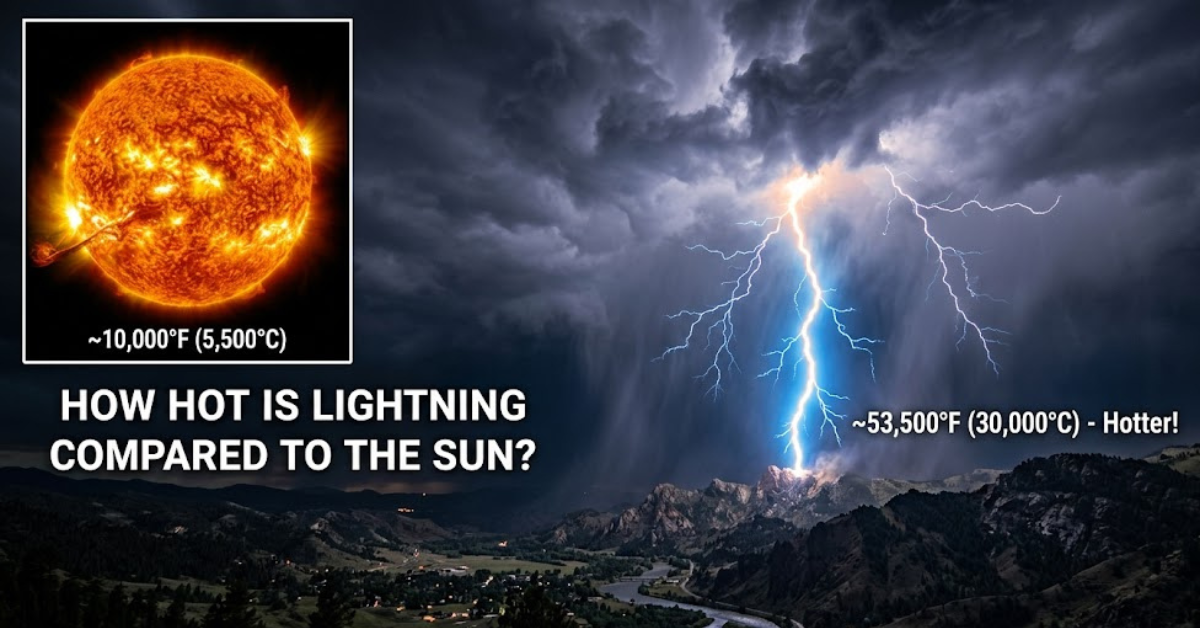
The short answer is this: lightning can reach temperatures of around 50,000 degrees Fahrenheit (27,760 degrees Celsius). That makes it several times hotter than the surface of the sun. Understanding how lightning gets so hot helps explain why thunderstorms are so dangerous and why lightning strikes create thunder, fires, and explosive energy.
In this guide, we’ll break down the science behind lightning temperature, compare it to the sun, and answer the most common questions people ask about lightning heat.
How Hot Is Lightning in Degrees?
A typical lightning bolt reaches temperatures of approximately:
- 50,000°F (degrees Fahrenheit)
- 27,760°C (degrees Celsius)
- 30,000 Kelvin
That incredible heat occurs almost instantly as electricity moves through the atmosphere. The lightning channel becomes superheated in less than a second, creating a burst of energy that rapidly expands the air around it.
This sudden expansion is what produces thunder.
How Hot Is Lightning in Fahrenheit?
Lightning temperatures are usually estimated at around 50,000 degrees Fahrenheit. To put that into perspective:
- Lava averages between 1,300°F and 2,200°F
- A kitchen oven reaches about 500°F
- The surface of the sun is around 10,000°F
That means a lightning strike is roughly five times hotter than the sun’s surface.
How Hot Is Lightning in Celsius?
Scientists estimate that lightning reaches nearly 27,760 degrees Celsius during a strike. That level of heat is extreme enough to:
- Vaporize metal
- Split trees instantly
- Melt sand into glass-like formations called fulgurites
- Cause severe burns and fires
Even though the temperature is incredibly high, the heat only lasts for a very short period.
How Hot Is Lightning in Kelvin?
In Kelvin, lightning reaches approximately 30,000 K. Kelvin is commonly used in scientific measurements because it starts at absolute zero, making it useful for studying extreme temperatures like plasma and electrical discharges.
How Hot Is Lightning Compared to the Sun?
One of the most surprising facts about lightning is that it’s actually hotter than the surface of the sun.
The sun’s surface temperature averages around:
Tsun≈5,500∘CT_{sun}\approx 5,500^\circ C
Meanwhile, a lightning bolt can reach:
Tlightning≈27,760∘CT_{lightning}\approx 27,760^\circ C
That means lightning is about five times hotter than the sun’s visible surface.
However, the comparison has an important catch. The sun maintains its heat continuously because of nuclear fusion happening in its core, while lightning only reaches peak temperature for a tiny fraction of a second.
How Hot Is a Lightning Bolt?
The core of a lightning bolt contains extremely hot plasma. Plasma is often called the fourth state of matter and forms when gases become electrically charged.
When lightning moves through the air:
- Electrical energy rapidly ionizes the air
- The air turns into plasma
- Temperatures spike almost instantly
- The surrounding air expands explosively
This process happens so fast that the heated air creates shock waves we hear as thunder.
A single bolt can carry up to one billion volts of electricity and tens of thousands of amps of current.
How Hot Is Lightning When It Strikes?
When lightning strikes an object or the ground, the temperature at the impact point remains incredibly high. The intense heat can:
- Ignite fires
- Explode tree bark
- Damage buildings
- Melt wires and metal surfaces
- Cause serious injury to humans and animals
The heat itself is not the only danger. Lightning also carries massive electrical energy that travels through conductive materials, including water and metal.
How Hot Is Lightning When It Hits the Ground?
The temperature of lightning when it hits the ground can still exceed 27,000°C. Sand and soil exposed to direct strikes may fuse into glassy tubes called fulgurites.
These natural glass formations provide evidence of just how intense a lightning strike can be.
In rocky areas, lightning may even crack or shatter stone because of the rapid heating and expansion.
Why Is Lightning So Hot?
Lightning becomes extremely hot because of electrical resistance in the atmosphere.
Here’s a simple explanation:
- Storm clouds build up electrical charges
- Opposite charges attract each other
- Electricity suddenly rushes through the air
- Air molecules collide at high speeds
- Massive heat is generated instantly
Since air is normally a poor conductor of electricity, forcing electricity through it creates enormous resistance and heat.
Can Anything Be Hotter Than Lightning?
Yes. While lightning is incredibly hot, some things in the universe are even hotter.
Examples include:
- The core of the sun
- Nuclear explosions
- Certain stars
- Supernovae
- Particle accelerator collisions
Still, lightning remains one of the hottest naturally occurring events on Earth.
How Hot Is Lightning on Jupiter?
Lightning on Jupiter may be even more powerful than lightning on Earth. Scientists believe Jupiter’s lightning storms can generate enormous electrical discharges because of the planet’s massive atmosphere and intense weather systems.
NASA observations suggest that Jovian lightning may:
- Travel longer distances
- Produce stronger radio waves
- Release more total energy
However, exact temperature measurements remain difficult because Jupiter’s atmosphere is vastly different from Earth’s.
What Happens to the Air Around Lightning?
The air surrounding a lightning channel heats up so quickly that it expands violently. This rapid expansion creates pressure waves that move outward as thunder.
The process works like this:
- Lightning superheats the air
- Air expands explosively
- Shock waves form
- Thunder travels through the atmosphere
Because light travels faster than sound, we see lightning before hearing thunder.
Interesting Facts About Lightning Heat
Here are some surprising facts about lightning temperatures:
- Lightning is hotter than the surface of the sun
- A single bolt lasts less than one second
- Lightning can strike the same place multiple times
- Temperatures rise faster than almost anything on Earth
- Sand struck by lightning can turn into glass
- Lightning produces plasma, not ordinary fire
Is Lightning Hot Enough to Melt Metal?
Yes, lightning is easily hot enough to melt many metals.
For example:
- Aluminum melts at around 660°C
- Steel melts at about 1,370°C to 1,540°C
- Copper melts at 1,085°C
Since lightning can exceed 27,000°C, it can instantly melt or vaporize certain materials.
FAQs About Lightning Temperature
How hot is lightning compared to the sun?
Lightning is roughly five times hotter than the sun’s surface. A lightning bolt can reach around 27,760°C, while the sun’s surface averages about 5,500°C.
How hot is lightning in Celsius?
Lightning reaches approximately 27,760 degrees Celsius.
How hot is lightning in Fahrenheit?
A typical lightning strike reaches about 50,000 degrees Fahrenheit.
How hot is lightning in Kelvin?
Lightning temperatures are estimated at around 30,000 Kelvin.
How hot is a lightning strike?
A lightning strike can heat the surrounding air to temperatures hotter than the sun’s surface almost instantly.
Can lightning melt sand?
Yes. Lightning can melt sand and create glass-like structures called fulgurites.
Why does lightning create thunder?
Thunder happens because lightning rapidly heats and expands the surrounding air, producing shock waves.
Is lightning hotter than lava?
Yes. Lightning is far hotter than lava. Lava usually reaches around 2,200°F, while lightning can exceed 50,000°F.
Conclusion
Lightning is one of the most extreme natural phenomena on Earth. With temperatures reaching around 50,000°F, it’s far hotter than the surface of the sun and powerful enough to melt metal, vaporize materials, and create explosive shock waves in the atmosphere.
Understanding how hot lightning is helps explain why thunderstorms are both fascinating and dangerous. From plasma formation to thunder generation, every lightning strike is a reminder of the immense energy hidden within nature.
If you enjoyed learning about lightning temperatures, you may also want to explore related topics like how thunder forms, why lightning strikes happen, and the science behind extreme weather events.