
For decades, Mars has captured human imagination. From science fiction movies to real-world space missions, the idea of living on the Red Planet feels both exciting and terrifying. But one question keeps coming up: can humans survive on Mars?
The short answer is yes — but not easily. Mars is one of the most hostile environments humans could ever face. The planet has freezing temperatures, almost no breathable oxygen, deadly radiation, and dust storms powerful enough to cover the entire planet. Even so, scientists believe survival may eventually be possible with advanced technology, careful planning, and self-sustaining habitats.
In this article, we’ll explore how humans could live on Mars, the biggest obstacles astronauts would face, and how long humans can survive on Mars with current and future technology.
Why Mars Is Considered Humanity’s Best Option
Among all the planets in our solar system, Mars is often viewed as the most realistic option for human colonization. While it’s still extremely dangerous, it has several features that make survival more possible than on planets like Venus or Mercury.
Here’s why scientists focus heavily on Mars:
- It has a day length similar to Earth
- Water ice exists beneath the surface
- The planet experiences seasons
- Gravity exists, although weaker than Earth’s
- Resources may eventually support fuel and oxygen production
Mars is also relatively close compared to other planets. Depending on orbital positions, a trip from Earth to Mars could take around six to nine months.
What Makes Mars So Dangerous?
Even though Mars may be the best candidate for future colonization, humans cannot survive there without protection. The environment is incredibly hostile to life.
Thin Atmosphere
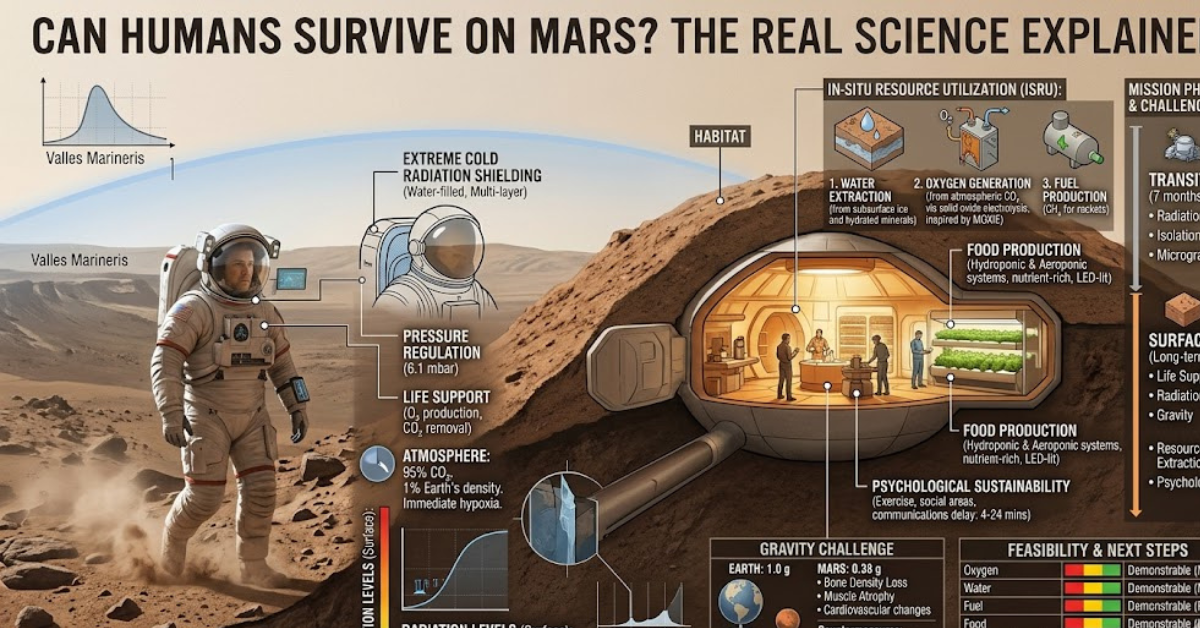
Mars has a very thin atmosphere made mostly of carbon dioxide. Oxygen levels are practically nonexistent, meaning humans would suffocate within minutes without a pressurized suit or habitat.
The atmospheric pressure is also extremely low. Without protection, bodily fluids could begin to boil due to the lack of pressure.
Freezing Temperatures
Average temperatures on Mars are around minus 80 degrees Fahrenheit (minus 62 degrees Celsius). Near the poles, temperatures can drop even lower.
Any human settlement would need advanced heating systems and insulated living spaces to survive the brutal cold.
Dangerous Radiation
Earth is protected by a strong magnetic field and thick atmosphere that shield us from harmful cosmic radiation. Mars lacks both.
This means astronauts on Mars would face constant exposure to radiation from space and the Sun. Over time, this exposure could increase the risk of:
- Cancer
- DNA damage
- Nervous system problems
- Weakened immune function
Radiation remains one of the biggest barriers to long-term survival.
Toxic Dust Storms
Mars is famous for its giant dust storms, some of which can engulf the entire planet for weeks. Martian dust is extremely fine and may contain toxic chemicals called perchlorates.
These storms could damage equipment, reduce solar power generation, and create health risks for astronauts.
How Can Humans Survive on Mars?
The idea of surviving on Mars depends entirely on technology. Humans would need artificial environments that recreate many of the conditions found naturally on Earth.
Pressurized Habitats
Astronauts would likely live inside sealed habitats designed to maintain:
- Breathable oxygen
- Stable air pressure
- Safe temperatures
- Radiation protection
Some concepts involve underground bases or habitats covered with Martian soil to block radiation.
Producing Oxygen
Scientists are already experimenting with ways to create oxygen on Mars. One promising approach involves extracting oxygen from carbon dioxide in the Martian atmosphere.
NASA successfully tested this technology through the MOXIE experiment carried aboard the Perseverance rover.
Finding Water
Water is essential for survival, farming, and fuel production. Fortunately, Mars contains frozen water beneath its surface and near the poles.
Future missions may mine this ice and purify it for drinking and agriculture.
Growing Food
Shipping food from Earth forever would be unrealistic. Long-term settlements would need greenhouses and hydroponic farming systems.
Researchers are studying whether plants can grow in Martian soil with proper treatment and nutrients.
Possible future crops include:
- Potatoes
- Lettuce
- Wheat
- Tomatoes
- Beans
Generating Power
Reliable energy is critical on Mars. Potential energy sources include:
- Solar panels
- Nuclear reactors
- Fuel produced from Martian resources
Because dust storms can reduce sunlight, many experts believe nuclear energy may be the most dependable long-term solution.
How Long Can Humans Survive on Mars?
The answer depends on the level of preparation and technology available.
Without protective equipment, a human would survive only a few minutes on the Martian surface due to lack of oxygen and pressure.
With modern spacesuits and habitats, astronauts could potentially survive for months or even years. NASA and private companies are actively researching systems designed for extended missions.
However, long-term survival still faces major challenges:
- Radiation exposure over many years
- Mental health effects from isolation
- Limited medical care
- Equipment failures
- Dependence on Earth supplies
At the moment, no human has lived on Mars, so many unknowns remain.
The Physical Effects of Living on Mars
Even if humans manage to survive, living on Mars could seriously affect the body.
Lower Gravity
Mars has only about 38% of Earth’s gravity. Over time, reduced gravity may cause:
- Muscle loss
- Bone weakening
- Balance problems
- Cardiovascular changes
Astronauts aboard the International Space Station already experience some of these effects in microgravity.
Mental Health Challenges
Life on Mars would involve isolation, confinement, and communication delays with Earth. Messages between Earth and Mars can take up to 20 minutes one way.
This could create emotional stress, loneliness, and psychological strain for crew members.
Could Humans Eventually Build Cities on Mars?
Many scientists and space companies believe permanent settlements on Mars are possible in the future. Companies like SpaceX are already developing spacecraft intended for human missions to the planet.
A future Martian colony could include:
- Underground habitats
- Research stations
- Greenhouses
- Water extraction facilities
- Energy plants
Some experts even discuss the possibility of terraforming Mars, which means changing the planet’s environment to make it more Earth-like. However, this idea would require enormous technological breakthroughs and could take hundreds or thousands of years.
Challenges That Still Need Solutions
Before humans can truly live on Mars permanently, several major issues must be solved.
Key Problems Scientists Are Working On
- Safe transportation to and from Mars
- Radiation shielding
- Sustainable food production
- Waste recycling systems
- Reliable medical care
- Long-term habitat construction
Every successful Mars mission helps researchers move one step closer to understanding whether permanent human survival is realistic.
What Would a Typical Day on Mars Look Like?
A normal day on Mars would be very different from life on Earth.
Astronauts might spend their days:
- Maintaining life-support systems
- Conducting scientific experiments
- Growing food
- Repairing equipment
- Exercising to maintain muscle strength
- Exploring the Martian surface
Because resources would be limited, every activity would need careful planning.
FAQs
Can humans survive on Mars without a spacesuit?
No. Mars has almost no breathable oxygen and extremely low air pressure. A person exposed to the surface without protection would quickly lose consciousness and die.
How can humans survive on Mars long term?
Humans would need pressurized habitats, oxygen production systems, water extraction technology, radiation shielding, and reliable food supplies to survive long term.
How long can humans survive on Mars with current technology?
With proper habitats and life-support systems, astronauts could potentially survive for months or years. Without protection, survival would last only minutes.
Is there water on Mars?
Yes. Scientists have discovered frozen water beneath the Martian surface and near the polar regions.
Could humans breathe on Mars someday?
Not naturally. Mars lacks enough oxygen in its atmosphere. Any breathable air would need to be artificially produced.
Will humans live on Mars in the future?
Many scientists believe humans may eventually establish settlements on Mars, but permanent colonization is still decades away.
Conclusion
So, can humans survive on Mars? Scientifically speaking, the answer appears to be yes — but only with advanced technology and enormous preparation. Mars is not naturally suited for human life, and surviving there would require artificial habitats, oxygen production, radiation protection, and sustainable food systems.
The dream of living on Mars is no longer pure science fiction. Space agencies and private companies are already building the technologies needed to make it possible. Still, huge challenges remain before humans can safely call the Red Planet home.
As research continues, Mars may eventually become humanity’s first step toward becoming a multi-planet species. Until then, the question is not just whether humans can survive there, but whether we can build a future worth living on another world.