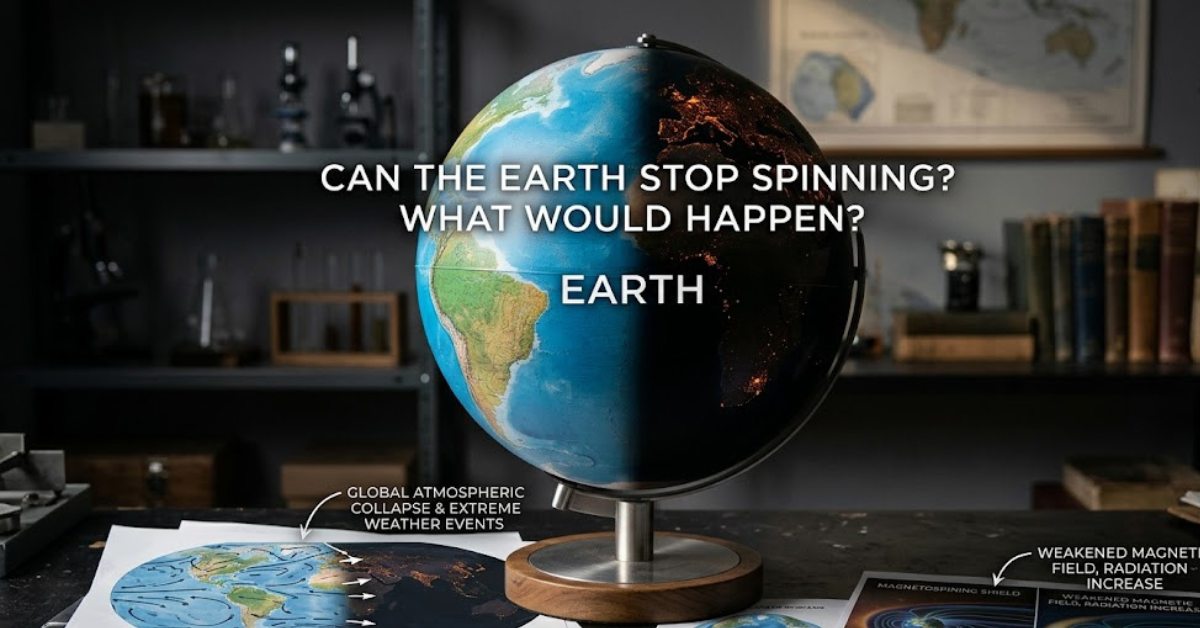

Imagine waking up one day and realizing the Sun never moves across the sky. Oceans begin flooding continents, winds become unimaginably violent, and the normal rhythm of day and night disappears. It sounds like science fiction, but many people wonder: can the Earth stop spinning?
The short answer is yes, technically it could happen — but not in the way movies usually show. Earth’s rotation is controlled by the laws of physics, and stopping it would require an enormous force. Understanding how our planet spins, and what keeps it moving, reveals just how delicate and fascinating our world really is.
In this article, we’ll explore how Earth’s rotation works, how can the Earth stop spinning, what scientists say about the possibility, and what would happen if it ever did.
Why Does the Earth Spin?
Earth spins because of the way the solar system formed around 4.5 billion years ago. A massive cloud of gas and dust collapsed under gravity, and as it shrank, it began rotating faster — much like a figure skater pulling in their arms.
That spinning motion never disappeared. In space, there’s very little friction to slow objects down, so Earth has continued rotating ever since.
Today, Earth spins at roughly:
- 1,670 kilometers per hour (1,037 mph) at the equator
- One full rotation every 24 hours
This rotation is what creates:
- Day and night
- Time zones
- Weather patterns
- Ocean currents
Without it, life on Earth would look completely different.
Can the Earth Stop Spinning Naturally?
Under normal conditions, Earth is extremely unlikely to suddenly stop spinning.
However, the planet’s rotation is slowing down very slightly over time. Scientists estimate that Earth’s days become about 1.7 milliseconds longer every century. That slowdown happens mainly because of the Moon’s gravitational pull, which creates tidal friction in the oceans.
So while Earth is gradually losing rotational speed, the process is incredibly slow. At this rate, it would take billions of years for any dramatic change to occur.
How Can the Earth Stop Spinning?
If you’re asking how can the Earth stop spinning, the answer involves forces powerful enough to overcome the planet’s angular momentum.
Several theoretical scenarios could affect Earth’s rotation:
1. A Massive Asteroid Collision
A giant asteroid impact could alter Earth’s rotation speed. Scientists believe past impacts have already slightly changed the planet’s spin.
But to completely stop Earth’s rotation, the object would need to be unimaginably huge — far larger than the asteroid that wiped out the dinosaurs.
An impact of that scale would likely destroy most life long before the planet stopped spinning.
2. Gravitational Interactions
Large celestial bodies can influence planetary rotation through gravity. For example:
- The Moon affects Earth’s tides
- Some moons in the solar system are “tidally locked”
- Venus rotates extremely slowly compared to Earth
Over an enormous timescale, gravitational forces can significantly change how planets rotate.
3. Internal Planetary Changes
Earth’s liquid outer core and shifting tectonic plates slightly influence rotation. Earthquakes can even shorten days by tiny fractions of a second.
For example, major earthquakes have measurably altered Earth’s spin, though only by milliseconds.
Still, these changes are nowhere near enough to stop the planet entirely.
What Would Happen If Earth Suddenly Stopped Spinning?
This is where things become truly terrifying.
If Earth stopped rotating instantly while the atmosphere continued moving, nearly everything on the surface would be swept away by winds traveling over 1,000 mph.
Here’s what could happen.
Catastrophic Winds and Destruction
Everything not anchored deep underground would continue moving at Earth’s original rotational speed.
That means:
- Buildings would collapse
- Trees would be uprooted
- Vehicles and debris would fly across the planet
- Massive shockwaves would spread worldwide
The atmosphere itself would keep moving, creating winds stronger than the most violent hurricanes ever recorded.
Oceans Would Flood Continents
Earth’s spin creates a slight bulge around the equator because of centrifugal force.
Without rotation:
- Water would shift toward the poles
- Some equatorial regions could become dry land
- Coastal areas elsewhere would flood dramatically
Entire continents would be reshaped.
Day and Night Would Change Completely
If Earth stopped spinning but still orbited the Sun, one side of the planet would face constant daylight while the other remained in permanent darkness for months at a time.
This would create extreme temperatures:
- Day side: scorching heat
- Night side: freezing cold
Many ecosystems would collapse under these conditions.
The Magnetic Field Could Be Affected
Earth’s magnetic field is linked to movement in the liquid outer core. While rotation is not the only factor, major changes to Earth’s spin could potentially weaken the magnetic field over time.
A weaker magnetic field would expose the planet to more solar radiation.
Would Humans Survive?
Human survival would depend on how the stopping happened.
If Earth Stopped Gradually
If the rotation slowed over millions of years, humans and ecosystems might adapt to changing conditions.
There would still be major consequences, including:
- Longer days and nights
- Shifting climate zones
- Changes in agriculture
- Different weather systems
But life could potentially continue.
If Earth Stopped Suddenly
A sudden stop would likely be an extinction-level event.
The immediate destruction from atmospheric momentum, earthquakes, tsunamis, and climate chaos would make survival extremely difficult.
Has Earth Ever Spun Faster or Slower?
Yes. Earth’s rotation has changed throughout history.
Scientists believe:
- Days were shorter in the distant past
- Dinosaurs experienced slightly shorter days than we do
- The Moon is slowly moving away from Earth
Hundreds of millions of years ago, a day may have lasted only around 22 hours.
This proves Earth’s rotation is not perfectly constant, even though the changes are tiny on a human timescale.
Could Humans Stop Earth’s Rotation?
No known human technology could stop Earth from spinning.
The amount of energy required is beyond comprehension. Even the largest nuclear explosions ever created are insignificant compared to the energy involved in planetary motion.
Human activity can influence climate and the environment, but not the fundamental rotation of the planet.
Why Earth’s Rotation Matters So Much
It’s easy to take Earth’s spin for granted because it feels completely normal to us. But rotation affects nearly every aspect of life.
Earth’s spin helps regulate:
- Temperatures
- Wind patterns
- Ocean currents
- Biological rhythms
- Weather systems
Without rotation, the planet would be far less hospitable.
FAQs
Can the Earth suddenly stop spinning?
In reality, a sudden stop is extraordinarily unlikely. Earth’s momentum keeps it rotating steadily, and stopping it would require an enormous external force.
What would happen if Earth stopped spinning for one second?
Even a brief stop could create devastating atmospheric effects, massive earthquakes, and extreme destruction because everything on the surface would still be moving.
Is Earth’s rotation slowing down?
Yes. Earth’s rotation slows very slightly over time due to tidal friction caused mainly by the Moon.
Could a black hole stop Earth’s rotation?
A nearby black hole would create catastrophic gravitational effects, but it would likely destroy Earth entirely before merely stopping its spin.
Would gravity disappear if Earth stopped spinning?
No. Gravity comes from Earth’s mass, not its rotation. You would still stay on the ground.
How fast is Earth spinning?
At the equator, Earth rotates at about 1,670 km/h (1,037 mph).
Conclusion
So, can the Earth stop spinning? In theory, yes — but under normal circumstances, it’s incredibly unlikely. Earth’s rotation is stabilized by the same physical laws that have kept planets moving for billions of years.
Still, exploring how can the Earth stop spinning gives us a fascinating look at the forces shaping our planet. It also highlights how important Earth’s rotation is to weather, oceans, climate, and life itself.
The next time you watch a sunrise or sunset, remember that you’re actually witnessing the result of a planet spinning through space at incredible speed — and doing so with remarkable stability.