
Have you ever stopped to think about how fast the Earth is moving right now? Even while you’re sitting completely still, the planet beneath you is spinning at incredible speeds. In fact, Earth is constantly rotating on its axis while also racing around the sun at tens of thousands of miles per hour.
Understanding how fast does the earth spin helps explain everything from day and night to weather patterns and even why we don’t feel the motion at all. The numbers are surprisingly huge, but the science behind them is easier to understand than most people think.
In this guide, we’ll break down how fast Earth spins on its axis, how quickly it travels around the sun, and why the speed changes depending on where you are on the planet.
How Fast Does the Earth Spin on Its Axis?
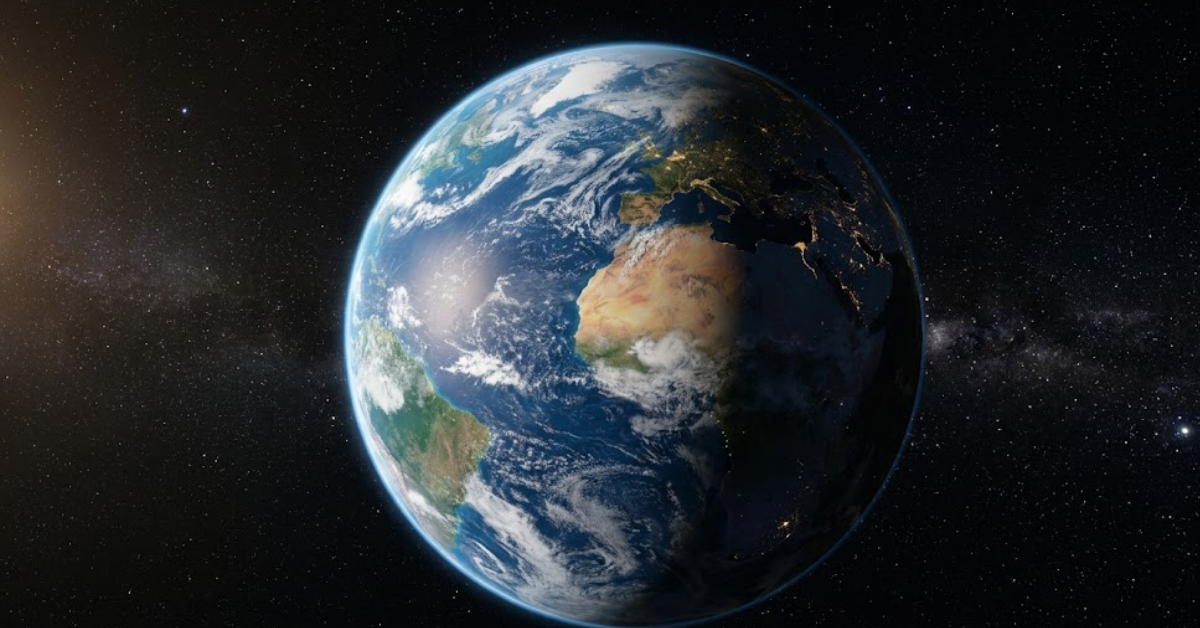
Earth rotates on an imaginary line called its axis. This axis runs from the North Pole to the South Pole. One complete rotation takes about 24 hours, which is why we experience day and night.
At the equator, the Earth spins at roughly 1,037 miles per hour (1,670 kilometers per hour). That means someone standing at the equator is traveling faster than the speed of sound simply because the planet is rotating.
v≈1037 mph at the equatorv \approx 1037\ \text{mph at the equator}v≈1037 mph at the equator
This rotation speed decreases as you move toward the poles because the circumference of Earth becomes smaller.
Why Does Earth Spin Faster at the Equator?
Imagine spinning a basketball. The middle section moves faster than the top and bottom because it covers more distance during each rotation. The same principle applies to Earth.
Here’s how the speed changes depending on location:
- Equator: About 1,037 mph
- Mid-latitudes: Slower than the equator
- North and South Poles: Nearly 0 mph
So, if you’re wondering how fast does the earth spin at the north pole, the answer is technically very slow compared to other regions.
How Fast Does the Earth Spin Around the Sun?
While Earth spins on its axis, it is also orbiting the sun at an astonishing speed. Earth travels around the sun at approximately 67,000 miles per hour (107,000 km/h).
v≈67000 mph around the Sunv \approx 67000\ \text{mph around the Sun}v≈67000 mph around the Sun
That’s fast enough to travel across the United States in just a few minutes. Despite this incredible motion, humans don’t notice it because the movement is smooth and constant.
Earth’s Orbit in Perspective
To better understand the scale:
- Earth travels about 1.6 million miles every day around the sun
- That equals roughly 66,700 mph every hour
- Per minute, Earth moves about 1,100 miles through space
- Per second, the planet covers around 18.5 miles
These numbers make space travel and planetary motion even more fascinating.
How Fast Does the Earth Spin in MPH?
One of the most searched questions online is how fast does the earth spin in mph. The answer depends on which motion you’re talking about.
Earth has two major movements:
- Rotation on its axis
- Revolution around the sun
Here are the average speeds:
- Rotation at the equator: 1,037 mph
- Orbit around the sun: 67,000 mph
Both motions happen simultaneously all the time.
How Fast Does the Earth Spin Per Hour, Minute, and Second?
Breaking Earth’s movement into smaller time units makes the speed easier to visualize.
Earth’s Rotational Speed
At the equator:
- Per hour: About 1,037 miles
- Per minute: Around 17.3 miles
- Per second: Roughly 0.29 miles
Earth’s Orbital Speed Around the Sun
- Per hour: Around 67,000 miles
- Per minute: Approximately 1,117 miles
- Per second: Nearly 18.5 miles
These figures show just how dynamic our planet really is.
Why Don’t We Feel the Earth Spinning?
This is one of the most interesting questions in astronomy. If Earth spins so fast, why can’t we feel it?
The answer comes down to constant motion and gravity.
Here’s why we don’t notice the spinning:
- Earth rotates at a steady speed
- Gravity keeps us firmly attached to the surface
- The atmosphere moves with the planet
- Humans only feel acceleration or sudden changes in speed
It’s similar to riding in a smooth airplane. You may be traveling hundreds of miles per hour, but it feels still because everything around you moves together.
How Fast Does the Earth Spin at the Poles?
At the poles, the rotational speed is nearly zero. This happens because the poles are the exact points Earth rotates around.
v≈0 mph at the polesv \approx 0\ \text{mph at the poles}v≈0 mph at the poles
Someone standing at the North Pole technically turns in place once every 24 hours rather than traveling thousands of miles like someone at the equator.
Does the Earth’s Spin Ever Change?
Yes, but only slightly.
Scientists have discovered that Earth’s rotation can speed up or slow down by tiny fractions of a second due to factors like:
- Earthquakes
- Ocean currents
- Melting glaciers
- Movement inside Earth’s core
- Gravitational effects from the moon
These changes are extremely small and usually only measurable with atomic clocks.
What Would Happen If Earth Stopped Spinning?
If Earth suddenly stopped rotating, the consequences would be catastrophic.
Possible effects include:
- Massive tsunamis
- Violent winds exceeding 1,000 mph
- Extreme temperature changes
- Collapse of ecosystems
- Major disruptions to gravity and oceans
Thankfully, there is no realistic scenario in which Earth would abruptly stop spinning.
Interesting Facts About Earth’s Spin
Here are some fascinating facts most people don’t know:
- Earth’s rotation is gradually slowing over millions of years
- Dinosaurs experienced shorter days than we do today
- A day on Jupiter lasts only about 10 hours because it spins much faster
- Venus spins so slowly that one day there is longer than one year
- Earth bulges slightly at the equator due to its rotation
FAQs
How fast does the Earth spin on its axis in mph?
At the equator, Earth spins at roughly 1,037 miles per hour.
How fast does the Earth spin around the sun?
Earth travels around the sun at approximately 67,000 miles per hour.
How fast does the Earth spin per second?
At the equator, Earth rotates at about 0.29 miles per second. Around the sun, it moves nearly 18.5 miles per second.
How fast does the Earth spin in 24 hours?
Earth completes one full rotation every 24 hours, covering the planet’s entire circumference.
How fast does the Earth spin at the equator?
The equator experiences the highest rotational speed at about 1,037 mph.
How fast does the Earth spin at the poles?
The poles move very little during Earth’s rotation, so the speed is close to zero.
Has Earth’s spinning speed changed over time?
Yes. Earth’s rotation slowly changes due to natural geological and gravitational forces.
Conclusion
The answer to how fast does the earth spin is far more impressive than most people realize. Earth rotates on its axis at over 1,000 mph at the equator while simultaneously orbiting the sun at roughly 67,000 mph. Yet despite these enormous speeds, life feels calm and stable because the motion is constant and shared by everything around us.
Understanding Earth’s movement offers a fascinating glimpse into how our planet works and why astronomy continues to amaze scientists and everyday readers alike. If you enjoyed learning about Earth’s spin, exploring topics like gravity, space travel, and planetary science can reveal even more incredible facts about the universe we live in.