
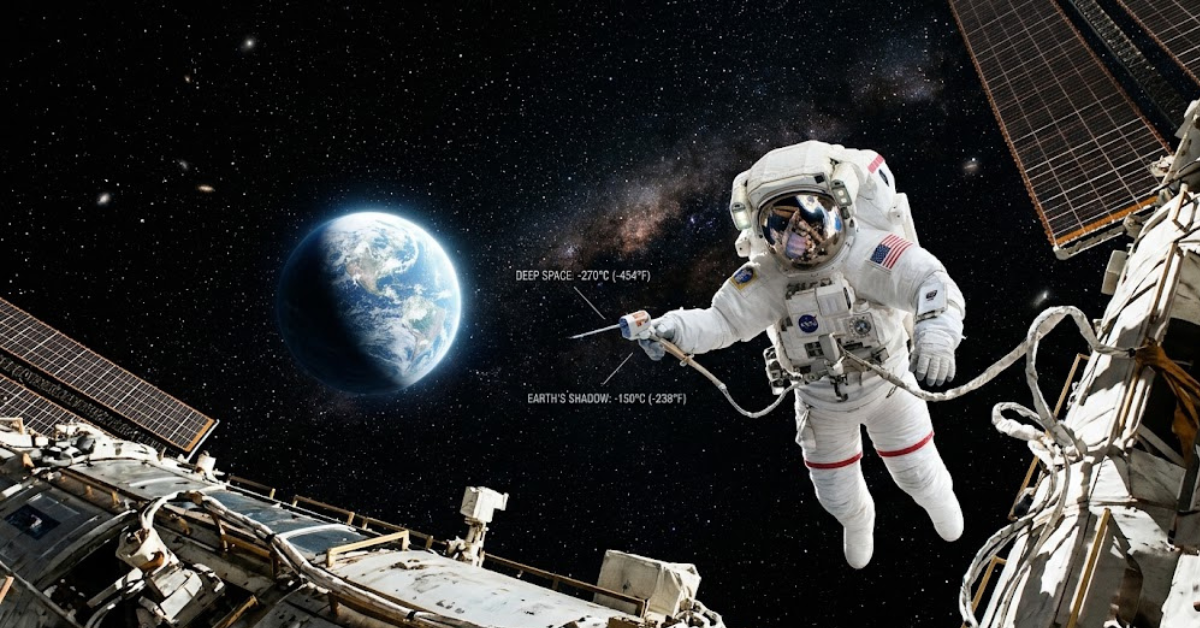

Space looks calm and empty from a distance, but it’s actually one of the harshest environments imaginable. One of the biggest questions people ask is: how cold is space? The answer is surprisingly complex because space doesn’t have a single temperature everywhere.
Depending on where you are in the universe, space can be unbelievably cold or extremely hot at the same time. Near planets, stars, and sunlight, temperatures vary dramatically. In deep space far from stars, temperatures drop close to absolute zero — the coldest possible temperature in physics.
In this guide, you’ll learn how cold space really is, how scientists measure it, and why temperatures change so much across the universe.
How Cold Is Space in Degrees?
The average temperature of deep space is about 2.7 Kelvin. That equals:
- Minus 270.45°C
- Minus 454.81°F
This temperature comes from something called the Cosmic Microwave Background Radiation, which is leftover heat from the Big Bang.
So when people ask how cold is space in degrees, the simplest answer is that most empty regions of the universe sit just a few degrees above absolute zero.
Absolute zero is:
- 0 Kelvin
- Minus 273.15°C
- Minus 459.67°F
At this point, atoms barely move at all.
How Cold Is Space in Celsius?
If you’re wondering how cold is space in Celsius, deep space averages around minus 270°C.
That’s colder than anything naturally found on Earth. Even Antarctica, the coldest place on our planet, only reaches around minus 89°C.
However, temperatures in space change depending on exposure to sunlight. Objects in direct sunlight can become extremely hot while shaded areas become extremely cold.
For example:
- Sunlit spacecraft surfaces may exceed 120°C
- Shadowed spacecraft parts can fall below minus 150°C
This happens because space is a vacuum, meaning there’s no air to distribute heat evenly.
How Cold Is Space in Fahrenheit?
For readers using the Fahrenheit scale, the temperature of deep space is around minus 455°F.
That number sounds unreal because Earth rarely experiences temperatures below minus 100°F even in extreme environments.
When astronauts travel outside spacecraft, their suits must protect them from both:
- Intense solar heat
- Extreme freezing temperatures
Without protection, the human body would rapidly lose heat in shaded areas of space.
How Cold Is Space in Kelvin?
Scientists often use Kelvin for astronomy and physics because it starts at absolute zero.
Deep space measures approximately:
- 2.7 Kelvin
That tiny amount of heat is leftover radiation filling the universe. Even completely empty space is not perfectly cold because traces of energy still exist everywhere.
Why Is Space So Cold?
Space is cold mainly because it lacks atmosphere and air molecules.
On Earth, air helps trap and transfer heat. In space, there’s almost nothing between objects. Heat cannot move efficiently through empty vacuum conditions.
Instead, energy travels mostly through radiation.
Here’s what makes space cold:
- No atmosphere to hold heat
- Very little matter to absorb energy
- Vast distances from stars
- Constant radiation loss
Objects only warm up when exposed to nearby stars or sunlight.
How Cold Is Space Around Earth?
Space around Earth is not as cold as deep interstellar space because our planet and the Sun provide heat.
Low Earth orbit temperatures vary dramatically:
- In direct sunlight: about 121°C (250°F)
- In shadow: about minus 157°C (minus 250°F)
This is why spacecraft and satellites require advanced thermal control systems.
Astronauts aboard the International Space Station experience these temperature swings regularly, although the station’s insulation keeps the interior comfortable.
How Cold Is Space Near Earth?
Many people search for how cold is space near Earth because they assume it’s uniformly freezing. In reality, temperatures depend heavily on sunlight exposure.
Near Earth:
- Sun-facing objects absorb intense solar radiation
- Dark areas lose heat rapidly
- Temperatures can shift within minutes
The vacuum itself doesn’t “feel” cold like winter air on Earth. Instead, heat escapes through radiation.
How Cold Is Space Above Earth?
Just a few hundred kilometers above Earth, the environment changes drastically.
Interestingly, parts of the upper atmosphere called the thermosphere can technically reach temperatures above 1,500°C. However, the air there is so thin that it wouldn’t feel hot to humans.
This confuses many people because:
- Temperature measures particle energy
- Heat depends on energy transfer
- Sparse particles transfer little actual heat
So space above Earth can contain extremely energetic particles while still behaving like a freezing environment.
How Cold Is Space Between Earth and Moon?
The space between Earth and the Moon experiences constant temperature extremes.
In sunlight:
- Temperatures may rise above 120°C
In darkness:
- Temperatures can plunge below minus 170°C
Because there’s no atmosphere between Earth and the Moon, there’s nothing to regulate temperatures smoothly.
This harsh environment was a major engineering challenge during the Apollo 11 Moon Landing missions.
How Cold Is Space on the Moon?
The Moon experiences some of the most dramatic temperature changes in the solar system.
On the lunar surface:
- Daytime temperatures reach 127°C (260°F)
- Nighttime temperatures fall to minus 173°C (minus 280°F)
The Moon lacks atmosphere, so heat escapes quickly after sunset.
Some permanently shadowed lunar craters may be even colder than Pluto because sunlight never reaches them.
How Cold Is Space Near the Sun?
This sounds strange, but space near the Sun can still be cold in some situations.
In direct sunlight near the Sun:
- Temperatures become extremely high
- Spacecraft require heavy heat shielding
However, shaded areas remain cold because vacuum doesn’t transfer heat effectively.
NASA’s Parker Solar Probe survives near the Sun by using a specialized heat shield while keeping sensitive instruments protected behind it.
How Cold Is Space Without the Sun?
Without stars like the Sun, space becomes incredibly cold.
Deep interstellar regions far from starlight approach:
- 2.7 Kelvin
- Minus 270°C
- Minus 455°F
These are some of the coldest environments known in nature.
Certain nebulae and gas clouds may even become slightly colder than the cosmic background due to unusual energy interactions.
How Cold is Our Solar System?
Temperatures across the solar system vary based on distance from the Sun.
Approximate examples include:
- Mercury daytime: 430°C
- Mars average: minus 63°C
- Jupiter cloud tops: minus 145°C
- Neptune: around minus 214°C
Farther planets receive less solar energy, making them dramatically colder.
How Do Astronauts Survive?
Astronauts survive because spacesuits act like miniature spacecraft.
Modern suits provide:
- Insulation
- Temperature regulation
- Oxygen supply
- Radiation protection
Inside the suit, liquid cooling systems help maintain safe body temperature despite extreme external conditions.
Without a suit, exposure to space would quickly become fatal.
Can Humans Freeze Instantly in Space?
Movies often exaggerate this.
Humans would not instantly freeze solid in space. Heat loss through radiation happens more slowly than in icy air or water.
However, unprotected exposure would still be deadly because of:
- Lack of oxygen
- Extreme pressure loss
- Radiation exposure
- Dangerous temperature extremes
Loss of consciousness would happen within seconds.
Interesting Facts About Space Temperature
Here are a few surprising facts about how cold space actually is:
- Deep space is colder than any natural place on Earth
- Sunlight in space feels intensely hot
- Spacecraft need heaters and cooling systems simultaneously
- The Moon has hotter days than deserts and colder nights than Antarctica
- Some regions of the universe are only a few degrees above absolute zero
FAQs
How cold is space actually?
Deep space averages around 2.7 Kelvin, which equals minus 270.45°C or minus 454.81°F.
How cold is space outside of Earth?
Space outside Earth can range from extremely hot in sunlight to extremely cold in shadow. Average deep-space temperatures remain near absolute zero.
Is space colder than Antarctica?
Yes. Antarctica’s coldest recorded temperature is around minus 89°C, while deep space is close to minus 270°C.
Why doesn’t the Sun heat all of space?
Space is mostly empty vacuum. Heat spreads poorly without matter, so temperatures vary dramatically depending on direct sunlight exposure.
How cold is space celsius?
The average temperature of deep space is approximately minus 270°C.
How cold is space fahrenheit?
Deep space averages around minus 455°F.
Is space completely freezing everywhere?
No. Areas exposed to stars can become extremely hot, while shaded regions become incredibly cold.
Conclusion
So, how cold is space? In most regions far from stars, space sits just above absolute zero at around minus 270°C or minus 455°F. But temperature in space is far from simple. Conditions can shift dramatically depending on sunlight, nearby planets, and cosmic radiation.
From the freezing darkness between galaxies to the scorching sunlight near stars, space is filled with extremes that challenge both astronauts and spacecraft. Understanding these temperatures helps scientists design missions, explore planets, and learn more about the universe itself.
If you enjoyed learning about space temperatures, you might also like exploring topics such as black holes, the coldest planets, or how astronauts survive in orbit.