

Have you ever looked up at the sky and wondered how fluffy white clouds appear out of nowhere? Clouds may seem magical, but they are actually the result of a fascinating scientific process happening in Earth’s atmosphere every day. Understanding how are clouds formed helps us learn more about weather, rain, storms, and the water cycle.
In simple terms, clouds form when warm air carrying water vapor rises into the atmosphere, cools down, and changes into tiny water droplets or ice crystals. These droplets gather together and become visible as clouds. While the process sounds simple, several important steps work together to create the different cloud shapes and types we see in the sky.
In this guide, you’ll learn exactly how clouds form, what they are made of, and why they are important for life on Earth.
What Are Clouds Made Of?
Before learning how clouds are formed in the atmosphere, it helps to know what clouds actually contain.
Clouds are made of:
- Tiny water droplets
- Ice crystals
- Water vapor
- Dust or small particles in the air
Most clouds begin with water vapor, which is an invisible gas created when water evaporates from oceans, lakes, rivers, and even plants.
Even though clouds look soft and lightweight, some large storm clouds can contain millions of pounds of water.
How Are Clouds Formed in the Sky?
The process starts with the sun heating Earth’s surface. Water from oceans, rivers, and lakes evaporates into the air as water vapor. Warm air rises because it is lighter than cool air.
As the warm air rises higher into the atmosphere, it cools down. Cooler air cannot hold as much moisture, so the water vapor changes into tiny droplets through a process called condensation.
These droplets stick to tiny particles like dust or smoke in the air. When billions of droplets gather together, they form a cloud.
Simple Steps of Cloud Formation
- The sun heats water on Earth.
- Water evaporates into vapor.
- Warm moist air rises upward.
- The air cools at higher altitudes.
- Condensation occurs.
- Tiny droplets gather and form clouds.
This process is a key part of the water cycle.
What Is Condensation? How Are Clouds Formed?
Condensation is the process where water vapor changes back into liquid water.
You can see condensation happen in everyday life when water droplets form on the outside of a cold glass. The same thing happens in the atmosphere when warm moist air cools.
Without condensation, clouds could not exist. It is one of the most important parts of cloud formation and weather systems.
How Are Clouds Formed in the Water Cycle?
Clouds play a major role in the water cycle, which constantly moves water around Earth.
The water cycle includes:
- Evaporation
- Condensation
- Precipitation
- Collection
Here’s how clouds fit into the cycle:
Evaporation
Heat from the sun turns liquid water into vapor.
Condensation
The vapor rises, cools, and forms clouds.
Precipitation
When droplets become heavy, they fall as rain, snow, or hail.
Collection
Water gathers again in rivers, oceans, and lakes.
Then the cycle repeats continuously.
How Are Clouds Formed Simple Explanation
If you need a quick and easy explanation, here it is:
Clouds form when warm moist air rises into the sky and cools down. The water vapor changes into tiny droplets that gather together to create clouds.
This explanation is perfect for beginners and young students.
How Are Clouds Formed for Kids?
Children often ask why clouds float in the sky. A kid-friendly explanation makes the concept easier to understand.
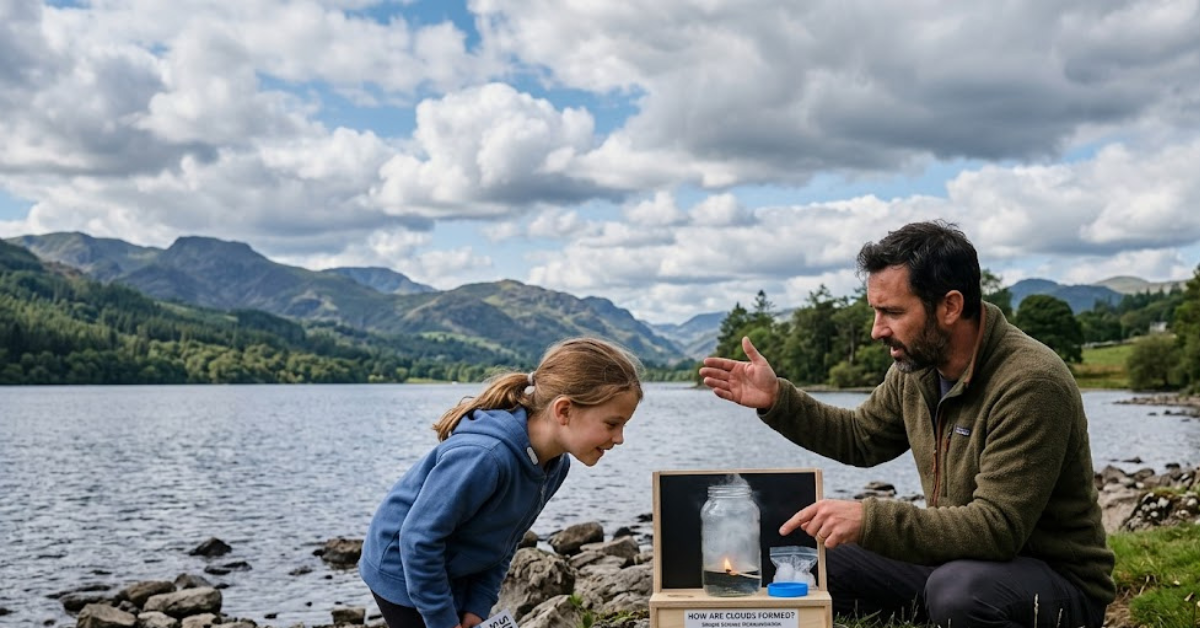
Imagine boiling water in a pot. Steam rises upward because it is warm. When the steam cools, tiny droplets appear. Clouds form in a similar way.
Easy Explanation for Kids
- The sun heats water.
- Water turns into invisible vapor.
- Vapor rises into the sky.
- Cold air changes vapor into tiny droplets.
- The droplets form clouds.
This is often taught in elementary science classes because it introduces children to weather and nature.
How Are Clouds Formed Class 3, 4, 5, 6, 7, and 9
Different school levels explain cloud formation with varying detail.
Class 3 and Class 4
Clouds form when water vapor rises and cools into tiny droplets.
Class 5 and Class 6
Students learn about evaporation, condensation, and the water cycle.
Class 7
Lessons include cloud types, weather systems, and precipitation.
Class 9
Students study atmospheric pressure, humidity, and scientific weather patterns in more detail.
How Are Clouds Formed and What Are They Made Of?
Clouds are formed from condensed water vapor and are mainly made of:
- Water droplets
- Ice crystals
- Air particles
The exact makeup depends on temperature and altitude. High clouds usually contain more ice crystals, while lower clouds mostly contain water droplets.
Types of Clouds
Not all clouds look the same because they form under different atmospheric conditions.
Cirrus Clouds
- Thin and wispy
- Found high in the sky
- Made mostly of ice crystals
Cumulus Clouds
- Puffy and white
- Usually linked with fair weather
Stratus Clouds
- Flat and gray
- Cover large parts of the sky
Cumulonimbus Clouds
- Tall storm clouds
- Produce thunder, lightning, and heavy rain
Understanding cloud types helps meteorologists predict weather changes.
Why Do Clouds Float?
Clouds may seem heavy, but the tiny droplets inside them are extremely light. Rising warm air and atmospheric movement keep them suspended in the sky.
Once the droplets become too heavy, gravity pulls them down as precipitation.
Why Are Clouds Important?
Clouds do much more than decorate the sky. They help Earth in several ways.
They Regulate Temperature
Clouds can cool Earth by blocking sunlight and also trap heat during nighttime.
They Produce Rain
Without clouds, there would be no rain or snow.
They Support Life
Clouds are essential for agriculture, drinking water, and ecosystems.
They Help Scientists Predict Weather
Meteorologists study clouds to forecast storms and climate patterns.
How Are Clouds Formed Very Short Answer
Clouds form when water vapor cools and condenses into tiny droplets in the atmosphere.
How Are Clouds Formed Short Answer
Warm moist air rises, cools, and changes into tiny water droplets that gather together to form clouds.
How Are Clouds Formed Diagram Explanation
A cloud formation diagram usually shows:
- Sun heating water
- Evaporation
- Rising warm air
- Cooling air
- Condensation
- Cloud formation
- Rainfall
These diagrams are commonly used in science textbooks because they visually explain the water cycle.
Interesting Facts About Clouds
- Some clouds can weigh more than a million pounds.
- Clouds appear white because they reflect sunlight.
- Fog is actually a cloud close to the ground.
- Clouds can move hundreds of miles with the wind.
- Different planets also have clouds made from chemicals other than water.
FAQs
How are clouds formed short answer class 1?
Clouds form when water vapor cools and turns into tiny water droplets in the sky.
How are clouds formed in the atmosphere?
Clouds form when warm moist air rises, cools, and condenses into droplets or ice crystals.
Why do clouds turn gray?
Clouds become gray when they grow thick enough to block sunlight from passing through.
Can clouds form without water?
No, clouds need moisture or water vapor to form.
Why do clouds produce rain?
When water droplets inside clouds become too heavy, they fall to Earth as rain.
Are clouds gas or liquid?
Clouds are mostly made of tiny liquid water droplets and ice crystals.
What causes different cloud shapes?
Wind, temperature, and atmospheric conditions create different cloud forms and sizes.
Conclusion
Understanding how are clouds formed gives us a better appreciation of the natural systems working above us every day. Clouds form through evaporation, rising warm air, cooling temperatures, and condensation. They are a vital part of the water cycle and play an important role in weather, climate, and life on Earth.
Whether you need a simple explanation for kids, a school-level answer, or a deeper scientific understanding, cloud formation is a fascinating topic that connects directly to our environment. Keep exploring weather science to learn even more about the incredible processes happening in the atmosphere around us.