
If you want stronger glutes, powerful hamstrings, and better hip mobility, the dumbbell romanian deadlift is one of the best exercises you can add to your routine. It looks simple, but when performed correctly, it delivers serious results for strength, posture, and athletic performance.
Unlike traditional deadlifts that start from the floor, this movement focuses on the hip hinge and controlled lowering phase. That makes it ideal for building the back side of your body while improving movement quality. Whether you’re a beginner or experienced lifter, learning proper technique can transform your lower-body training.
What Is a Dumbbell Romanian Deadlift?
The dumbbell Romanian deadlift, often shortened to RDL, is a hip-dominant exercise where you lower dumbbells down your legs while keeping a slight bend in the knees and a neutral spine. The movement emphasizes stretching and loading the hamstrings before driving the hips forward to stand tall again.
It’s commonly used in strength training, bodybuilding, sports performance, and general fitness programs.
Why It’s So Effective
- Targets glutes and hamstrings directly
- Improves hip hinge mechanics
- Builds lower-back endurance
- Enhances posture and balance
- Requires less setup than barbell deadlifts
- Great for home and gym workouts
Dumbbell Romanian Deadlift Muscles Worked
This exercise primarily trains the posterior chain, which includes the muscles on the back side of your body.
Primary Muscles
- Hamstrings – Control the lowering phase and help extend the hips
- Glutes – Power the standing portion of the lift
- Erector spinae – Stabilize the spine
Secondary Muscles
- Core muscles
- Forearms and grip
- Upper back
- Adductors
Because so many muscles work together, RDLs are excellent for both strength and body composition goals.
How to Do Dumbbell Romanian Deadlift Form Correctly
Mastering technique matters more than lifting heavy.
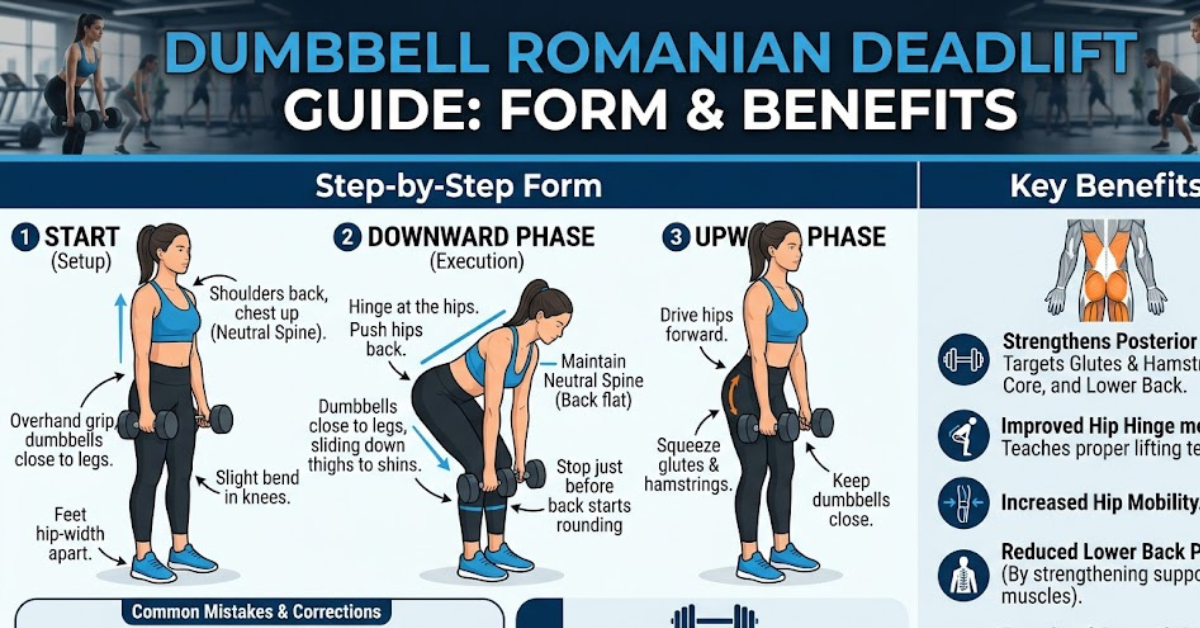
Step-by-Step Instructions
- Stand tall with a dumbbell in each hand.
- Keep feet hip-width apart.
- Slightly bend your knees.
- Push your hips backward while lowering the weights close to your legs.
- Keep your chest open and back flat.
- Lower until you feel a strong hamstring stretch.
- Drive hips forward and return to standing.
- Squeeze glutes at the top.
Form Tips
- Keep dumbbells close to your thighs and shins
- Move through the hips, not the knees
- Keep neck neutral
- Brace your core throughout
- Use control on the descent
Dumbbell Romanian Deadlift Proper Form Side View
From the side, your body should show a clean hip hinge pattern. Hips move backward while the torso leans forward naturally. Your spine stays neutral, and knees remain softly bent rather than squatting downward.
Think of closing a car door with your hips while holding groceries in both hands. That visual often helps beginners understand the movement instantly.
Common Mistakes to Avoid
Even strong lifters sometimes get this exercise wrong.
1. Turning It Into a Squat
Too much knee bend shifts work away from the hamstrings.
2. Rounding the Lower Back
Keep the chest proud and spine neutral.
3. Letting Weights Drift Forward
Keep dumbbells close to your body to reduce stress on the back.
4. Going Too Low
Only lower as far as mobility allows while maintaining form.
5. Hyperextending at the Top
Stand tall, but don’t lean backward excessively.
Benefits of the Dumbbell Romanian Deadlift Exercise
Builds Stronger Glutes
Hip extension is the main driver of the lift, making it excellent for glute development.
Develops Hamstring Size and Strength
The slow lowering phase creates serious tension through the hamstrings.
Improves Athletic Performance
Better hip power can help sprinting, jumping, and change of direction.
Supports Better Posture
Strengthening the posterior chain helps offset long hours of sitting.
Beginner-Friendly
Dumbbells are often easier to learn with than barbells.
Best Variations to Try
Single Leg Dumbbell Romanian Deadlift
A balance-focused version that trains one side at a time.
Best for: Stability, coordination, and correcting imbalances.
Staggered Stance RDL
One foot slightly behind the other for added support.
Best for: Beginners progressing toward single-leg work.
Tempo RDL
Use a slow 3–4 second lowering phase.
Best for: Muscle growth and control.
Suitcase RDL
Hold one dumbbell on one side only.
Best for: Core anti-rotation strength.
Dumbbell Romanian Deadlift vs Conventional Deadlift
| Feature | Dumbbell RDL | Conventional Deadlift |
| Start Position | Standing | Floor |
| Main Focus | Hamstrings & glutes | Full-body strength |
| Knee Bend | Slight | More pronounced |
| Learning Curve | Easier | Higher |
| Equipment Need | Minimal | Moderate |
Both are valuable, but RDLs are often easier to recover from and simpler to perform at home.
How to Program It in Your Workouts
Beginners
- 3 sets of 10–12 reps
Strength
- 4 sets of 6–8 reps
Muscle Growth
- 3–4 sets of 8–15 reps
Use it on leg day, lower-body sessions, or posterior chain focused workouts.
Dumbbell Romanian Deadlift for Women
This exercise is excellent for women aiming to build glutes, strengthen hamstrings, and improve confidence with free weights. It’s scalable, joint-friendly when performed properly, and effective for all fitness levels.
The movement also supports daily activities like lifting, bending, and carrying.
FAQ
What does the dumbbell Romanian deadlift work?
It mainly trains the glutes, hamstrings, lower back, and core.
Is the dumbbell RDL good for beginners?
Yes. It’s one of the best ways to learn the hip hinge pattern safely.
How heavy should I lift?
Choose a weight that challenges you while allowing full control and good posture.
Should I bend my knees a lot?
No. Keep only a slight bend. This is a hinge movement, not a squat.
How low should I go?
Lower until you feel a hamstring stretch while keeping your back neutral.
Can I do it at home?
Absolutely. All you need is a pair of dumbbells.
Conclusion
The dumbbell romanian deadlift is one of the smartest exercises for building strength, improving posture, and developing athletic lower-body power. It targets the muscles many people neglect while teaching better movement mechanics that carry into sports and daily life.
Focus on proper form, controlled reps, and steady progression. Add this movement to your weekly training plan, and you’ll likely notice stronger glutes, tighter hamstrings, and a more resilient body.