
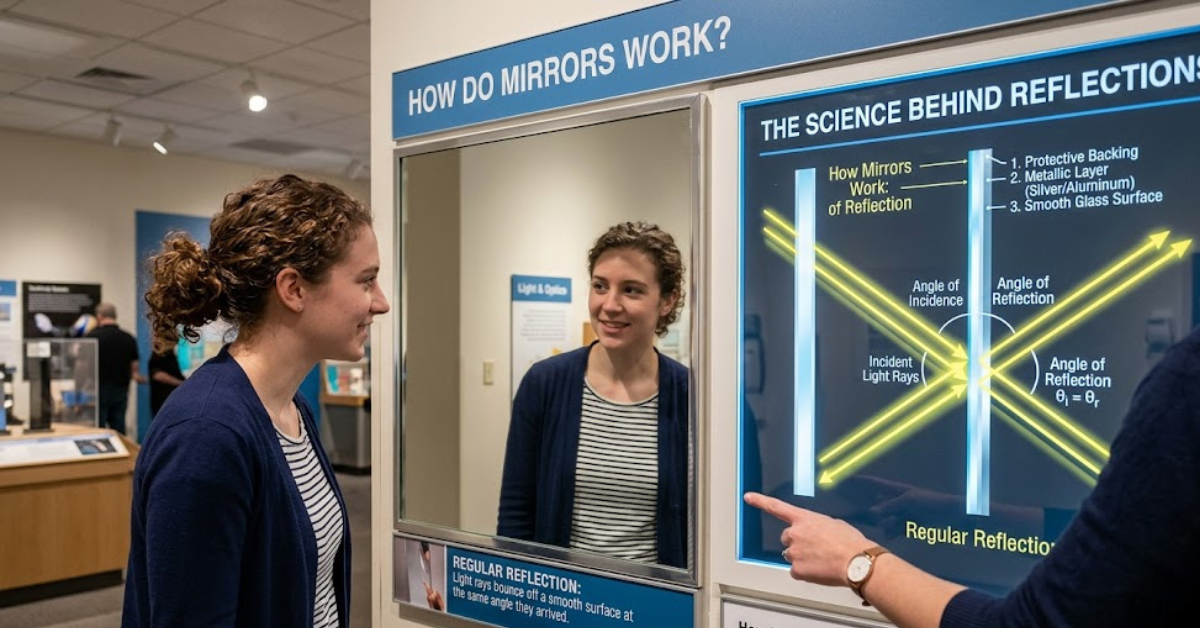

Rave you ever looked into a mirror and wondered why your reflection appears so perfectly? It feels almost magical, but the answer is rooted in science and physics. Understanding how do mirrors work helps explain everything from bathroom mirrors to giant space telescopes.
Mirrors are part of our daily lives, yet most people rarely think about what actually happens when they see themselves reflected back. The process involves light, smooth surfaces, and the way our eyes and brain interpret reflected images. In this guide, we’ll break down the science in a simple and engaging way so anyone can understand it.
What Is a Mirror?
A mirror is a smooth surface that reflects light in a very organized way. Most modern mirrors are made from glass coated with a thin layer of reflective metal, usually aluminum or silver.
When light hits this reflective surface, it bounces back instead of being absorbed. That reflected light travels to your eyes, allowing you to see an image.
The smoother the surface, the clearer the reflection. Rough surfaces scatter light in many directions, which is why you can’t see your face in a wall or piece of paper.
How Do Mirrors Work Scientifically?
To understand how do mirrors work scientifically, you first need to understand light.
Light travels in straight lines called rays. When these rays hit a mirror, they bounce off the surface. This process is called reflection.
The basic rule of reflection is:
θi=θr\theta_i = \theta_r
This means the angle at which light hits the mirror equals the angle at which it reflects away.
Because mirrors reflect light so evenly, your eyes can trace those rays backward and create the image you see.
Why Reflections Appear Behind the Mirror
Your brain assumes light travels in straight lines. When reflected rays enter your eyes, your brain extends those lines backward, making it seem like the image exists behind the mirror.
In reality, there’s no person inside the mirror. It’s simply your brain interpreting reflected light.
How Do Mirrors Work Physics Explained Simply
The physics behind mirrors is surprisingly elegant. Mirrors rely on a type of reflection called specular reflection.
Here’s how it works step by step:
- Light leaves an object, such as your face.
- The light travels toward the mirror.
- The mirror reflects the light at equal angles.
- The reflected light reaches your eyes.
- Your brain forms a visual image.
A rough surface causes diffuse reflection, where light scatters randomly. That’s why polished metal can reflect images while concrete cannot.
Reflection Formula
In physics, reflection can also be represented visually through ray diagrams. Flat mirrors create virtual images that appear upright and the same size as the object.
How Do Mirrors Work for Kids?
If you’re explaining mirrors to children, the easiest way is to compare light to bouncing balls.
Imagine throwing a ball at a wall. The ball bounces back. Light behaves similarly when it hits a mirror.
A simple kid-friendly explanation is:
- Light hits the mirror
- The mirror bounces the light back
- Your eyes see the bounced light
- Your brain creates the reflection
This simple idea helps children understand reflections without complicated scientific terms.
Why Are Mirrors Usually Made With Silver or Aluminum?
The reflective coating is one of the most important parts of a mirror. Metals like silver and aluminum reflect most visible light extremely well.
Silver creates very bright reflections, while aluminum is cheaper and more durable. Manufacturers place the metal coating behind glass to protect it from scratches and damage.
Without the metallic layer, ordinary glass would only reflect a small amount of light.
How Do Mirrors Work at an Angle?
When mirrors are tilted, the reflected light changes direction. This is why angled mirrors can let you see around corners or create unusual visual effects.
The same reflection law still applies:
- The incoming angle equals the outgoing angle
- Tilting the mirror changes where the light travels
Periscopes use angled mirrors to help people see over obstacles. Kaleidoscopes use multiple angled mirrors to create repeating patterns.
Types of Mirrors and How They Work
Not all mirrors are flat. Different mirror shapes reflect light differently.
Plane Mirrors
These are flat mirrors found in homes and bathrooms. They create upright images that appear normal in size.
Concave Mirrors
Concave mirrors curve inward. They can magnify images and focus light.
Examples include:
- Makeup mirrors
- Flashlights
- Reflecting telescopes
Convex Mirrors
Convex mirrors curve outward and spread light apart. They create smaller images but show a wider field of view.
They are commonly used in:
- Car side mirrors
- Security mirrors
- Parking garages
How Do Mirrors Work in Telescopes?
Large telescopes often use mirrors instead of lenses because mirrors can gather enormous amounts of light.
A telescope mirror reflects and focuses light from distant stars and galaxies into a single point so scientists can study them clearly.
Reflecting telescopes use curved mirrors to improve image brightness and reduce distortion.
Some of the world’s biggest observatories rely entirely on precisely engineered mirrors.
How Do Mirrors Work When Covered?
Many people ask how do mirrors work when covered or blocked.
A mirror only works if light can reach it and bounce back to your eyes. If the mirror is completely covered, light cannot reflect properly, so no image forms.
For example:
- A cloth over a mirror blocks reflection
- Fog or dust weakens reflected light
- Paint completely stops reflections
The mirror itself still has reflective properties, but the light path is interrupted.
How Do Mirrors Work When Blocked?
If part of a mirror is blocked, you can still see your reflection in the uncovered section.
This surprises many people because they assume each part of the mirror only reflects one area of the body. In reality, every visible part of the mirror reflects light from many directions.
That’s why even a small mirror can show your entire face if positioned correctly.
How Mirrors Are Used in Everyday Life
Mirrors do far more than show reflections. They’re essential in technology, transportation, science, and entertainment.
Common uses include:
- Cars and motorcycles
- Cameras
- Microscopes
- Laser systems
- Solar energy devices
- Medical instruments
Even smartphones and modern optical devices rely on tiny reflective surfaces.
How Do Mirrors Work in Video Games?
Video game mirrors are very different from real mirrors. In games, reflections are created digitally using rendering techniques.
Developers often use:
- Real-time reflections
- Ray tracing
- Reflection maps
Modern graphics technology simulates how light behaves to make virtual mirrors appear realistic.
Why Mirrors Reverse Left and Right
Mirrors don’t actually reverse left and right. They reverse front and back.
When you raise your right hand, your reflection appears to raise the opposite hand because you mentally rotate the image as if another person were facing you.
Scientifically, the mirror simply reflects light straight back.
Fun Facts About Mirrors
Here are a few interesting mirror facts:
- Ancient mirrors were made from polished stone or metal
- The first glass mirrors appeared thousands of years ago
- Some telescope mirrors are coated with gold
- One-way mirrors partially reflect and partially transmit light
- Animals sometimes recognize themselves in mirrors
Common Myths About Mirrors
Mirrors Double Light
Reflect light but do not create extra light.
Mirrors Flip Images Horizontally
Reverse depth, not left and right.
Broken Mirrors Stop Working
Broken mirror pieces still reflect light individually.
FAQs
How do mirrors work simple explanation?
Mirrors work by bouncing light back to your eyes in an organized way, allowing you to see reflections clearly.
How do mirrors work physics wise?
Mirrors follow the law of reflection, where the angle of incoming light equals the angle of reflected light.
How do mirrors work for kids?
Light bounces off a mirror like a ball bouncing off a wall. Your eyes see the bounced light and create a reflection.
How do mirrors work at an angle?
Angled mirrors redirect reflected light, changing what you can see based on the mirror’s position.
How do mirrors work in telescopes?
Telescope mirrors collect and focus light from distant objects to create clearer images of space.
Why can mirrors reflect images?
The smooth metallic surface reflects light evenly, preserving visual details instead of scattering them.
What happens if a mirror is covered?
A covered mirror cannot reflect visible light back to your eyes, so no image appears.
Conclusion
Understanding how do mirrors work reveals just how fascinating everyday objects can be. Mirrors rely on light reflection, smooth surfaces, and the laws of physics to create the images we see every day. From bathroom mirrors to massive observatory telescopes, the same scientific principles apply.
Whether you were curious about reflections, teaching kids about light, or exploring optics more deeply, mirrors offer a perfect example of science in action. If you enjoyed learning about reflection and light behavior, consider exploring other topics related to optics, vision, and physics to see how interconnected our world really is.