

If you’ve ever stopped mid-recipe wondering how many ounces in a cup, you’re definitely not alone. Cooking and baking often require quick conversions, and understanding cup-to-ounce measurements can save a lot of guesswork in the kitchen.
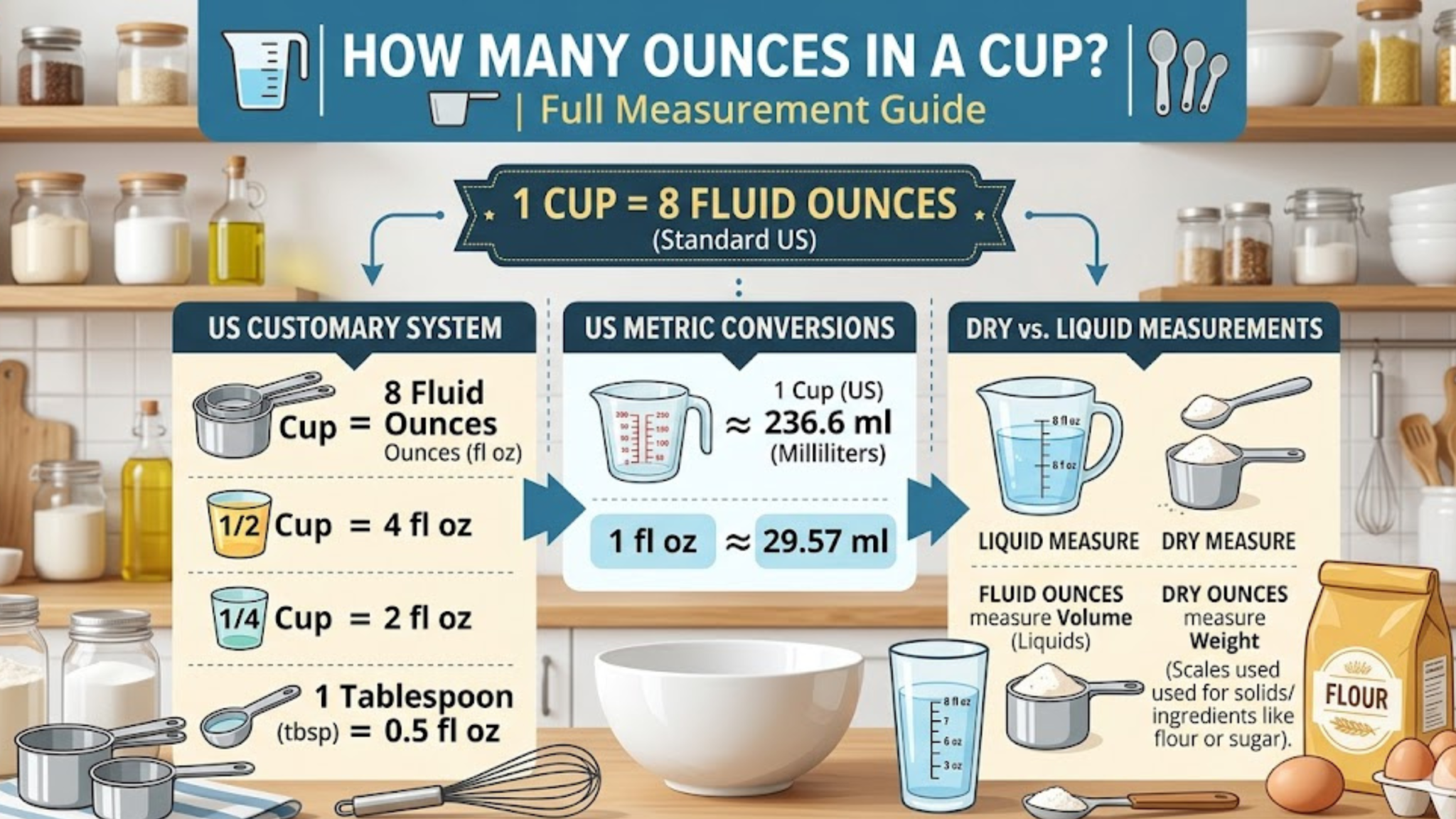
In simple terms, a standard US cup equals 8 fluid ounces. However, things change slightly when you start measuring dry ingredients, where weight depends on density and texture.
Let’s break it all down in a clear and practical way so you can cook with confidence every time.
Understanding How Many Ounces in a Cup
At its core, the answer to how many ounces in a cup depends on what you are measuring.
- 1 US cup = 8 fluid ounces (for liquids)
- Dry ingredients vary depending on weight and density
This is why baking recipes can sometimes feel confusing compared to cooking recipes.
How Many Ounces in a Cup of Liquid?
For liquids, the measurement is consistent and simple.
- Water: 8 fluid ounce
- Milk: 8 fluid ounce
- Coffee: 8 fluid ounce (standard cup)
Since liquids are measured by volume, they always follow the same conversion.
Dry Ingredients and Cup Measurements
Dry ingredients don’t follow a fixed rule because their weight changes based on density.
Here are some common examples:
- Flour: ~4.25 oz per cup
- Sugar: ~7 oz per cup
- Packed brown sugar: ~7.5 oz per cup
- Chocolate chips: ~6 oz per cup
This is why asking how many ounces in a cup dry doesn’t have a single fixed answer.
Common Kitchen Conversions
Dairy and Spreads
- Butter: 8 oz per cup (2 sticks = 1 cup)
- Sour cream: 8 oz per cup
- Peanut butter: ~8 oz per cup
- Shredded cheese: ~4 oz per cup
Baking Ingredients
- Flour: ~4.25 oz per cup
- Sugar: ~7 oz per cup
- Chocolate chips: ~6 oz per cup
Liquids
- Milk: 8 fluid ounce per cup
- Coffee: 8 fluid ounce per cup
- Water: 8 fluid ouncE per cup
How Many Ounces in a Cup and a Half?
Scaling recipes is common, especially in baking.
- 1 cup = 8 ounces
- 1.5 cups = 12 ounces
So, a cup and a half equals 12 fluid ounces for liquids.
Solid vs Liquid Measurements
One of the most common mistakes in cooking is mixing up weight and volume.
- Liquids measure volume (cups = fluid ounces)
- Solids measure weight (cups ≠ fixed ounces)
For example, a cup of flour does not weigh the same as a cup of sugar. This is why kitchen scales are often more accurate for baking.
Why Cup Measurements Can Vary
Even though the standard rule exists, real-world cooking depends on:
- Ingredient density
- Packing method (loose vs packed)
- Texture and moisture
For example, peanut butter or shredded cheese can vary slightly depending on how they’re measured.
Tips for Accurate Measuring
To improve accuracy in the kitchen:
- Use liquid measuring cups for liquids
- Use a kitchen scale for dry ingredients
- Spoon flour instead of scooping directly
- Pack brown sugar firmly for correct measurement
FAQs
1. How many ounce are in a cup?
A US cup equals 8 fluid ounces for liquids.
2. How many ounce in a cup of water?
Exactly 8 fluid ounces.
3. How many ounce in a cup of flour?
Around 4.25 ounce depending on measurement style.
4. How many ounces in a cup of sugar?
Approximately 7 ounces.
5. How many ounces in a cup of butter?
8 ounces (2 sticks).
6. How many ounces in a cup dry ingredients?
It depends on the ingredient’s density.
7. How many ounces in a cup of cheese?
About 4–5 ounces when shredded.
8. How many ounces in a cup of coffee?
8 fluid ounces.
9. How many ounces in a cup of milk?
8 fluid ounces.
10. How many ounces in a cup and a half?
12 fluid ounces.
Conclusion
Understanding how many ounces in a cup makes everyday cooking and baking much easier. While liquids consistently measure 8 fluid ounces per cup, dry ingredients vary depending on weight and density.
Once you learn these simple differences, you’ll be able to follow recipes more accurately and avoid common kitchen mistakes.
If you want even better results in cooking, using proper measuring tools and understanding conversions is a small step that makes a big difference.