
Even in today’s digital world, checks are still commonly used for rent, business payments, taxes, and personal transactions. Knowing how to fill one out correctly helps you avoid mistakes and ensures your payment goes through smoothly.
In this guide, you’ll learn exactly how to write a check, including examples for cents, large amounts, and special situations.
What Is a Check and Why It’s Still Used
A check is a written payment instruction that tells your bank to transfer money from your account to another person or organization.
People still use checks for:
- Rent payments
- Business transactions
- Government fees and taxes
- Personal payments
Even with online banking, checks remain a reliable payment method in many situations.
Parts of a Check You Should Know
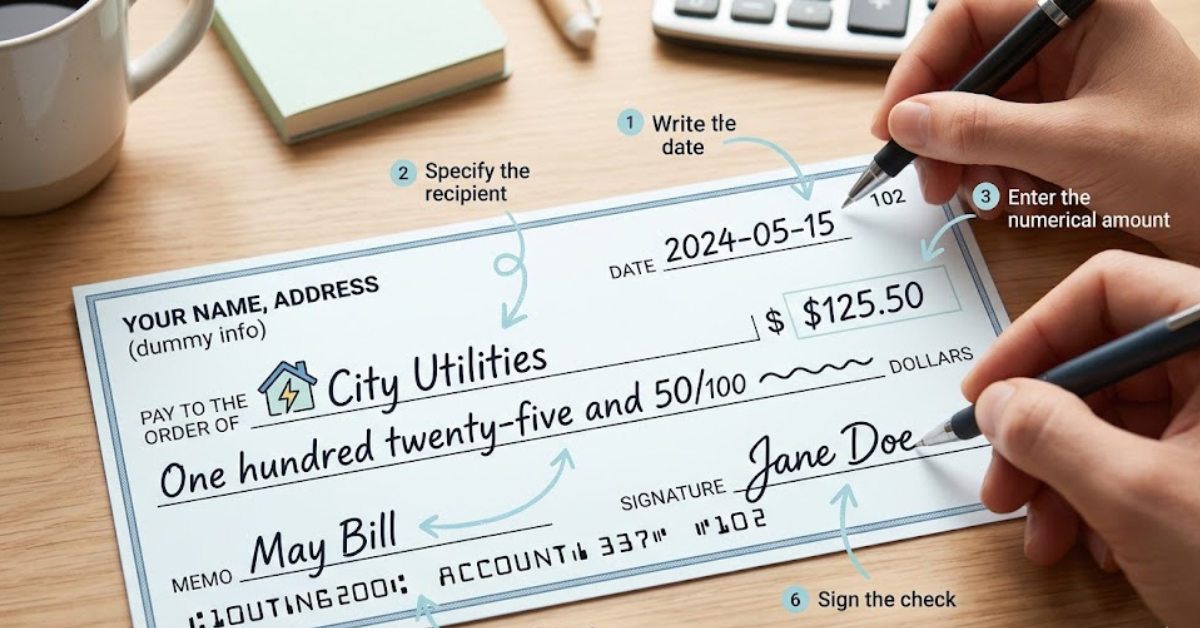
Before learning the process, understand the main sections:
- Date line – When the check is written
- Pay to the order of – Recipient’s name
- Amount box ($) – Number value
- Written amount line – Amount in words
- Memo line – Payment purpose (optional)
- Signature line – Your approval
Each part must match to avoid issues.
Step-by-Step: How to Fill Out a Check
Step 1: Write the date
Place today’s date in the top right corner.
Step 2: Write the recipient’s name
In the “Pay to the order of” line, write the name of the person or business.
Step 3: Enter the amount in numbers
Example: 500, 1000, 1500, etc.
Step 4: Write the amount in words
This confirms the payment amount in a legal format.
Step 5: Add a memo (optional)
You can write the reason, such as rent, groceries, or tuition.
Step 6: Sign the check
Your signature authorizes the payment.
How to Write a Check With Cents
When the amount includes cents, always write them as a fraction over 100.
Example:
$10.75 → Ten dollars and 75/100
This format helps prevent confusion or fraud.
How to Write a Check Without Cents
If there are no cents, simply use “00/100.”
Example:
$100 → One hundred and 00/100
How to Write Large Amounts (Thousands)
For larger payments, clarity is important.
Example:
$1,500.25 → One thousand five hundred and 25/100
This ensures accuracy for higher-value transactions.
Common Check Amount Examples
- $100 → One hundred and 00/100
- $500 → Five hundred and 00/100
- $1,000 → One thousand and 00/100
- $1,500 → One thousand five hundred and 00/100
These examples help you understand proper formatting.
Special Situations
Writing a check to cash
Write “Cash” in the payee line, but be careful—it can be risky if lost.
Writing a check to yourself
Simply write your own name as the recipient.
Writing a tax payment check
For U.S. taxes, checks are usually made payable to “United States Treasury” with instructions from the IRS.
Common Mistakes to Avoid
- Leaving blank spaces
- Not matching numbers and words
- Forgetting to sign
- Writing unclear handwriting
- Making spelling errors in the written amount
Even small mistakes can delay or cancel a payment.
Quick FAQs
How do I write a check correctly?
Fill in the date, recipient, amount in numbers and words, memo, and signature.
How do you write cents on a check?
Use a fraction like 25/100 after the dollar amount.
Can I write a check to myself?
Yes, just use your own name as the recipient.
What happens if I make a mistake?
Banks may reject or return the check.
Is writing a check still safe?
Yes, as long as you fill it out carefully and avoid leaving blanks.
Conclusion
Learning how to write a check is still a valuable financial skill. Whether you’re paying rent, sending money, or handling business transactions, understanding the correct format helps ensure accuracy and security.
Once you practice a few times, writing checks becomes quick and easy—and you’ll avoid common mistakes that could cause delays.