
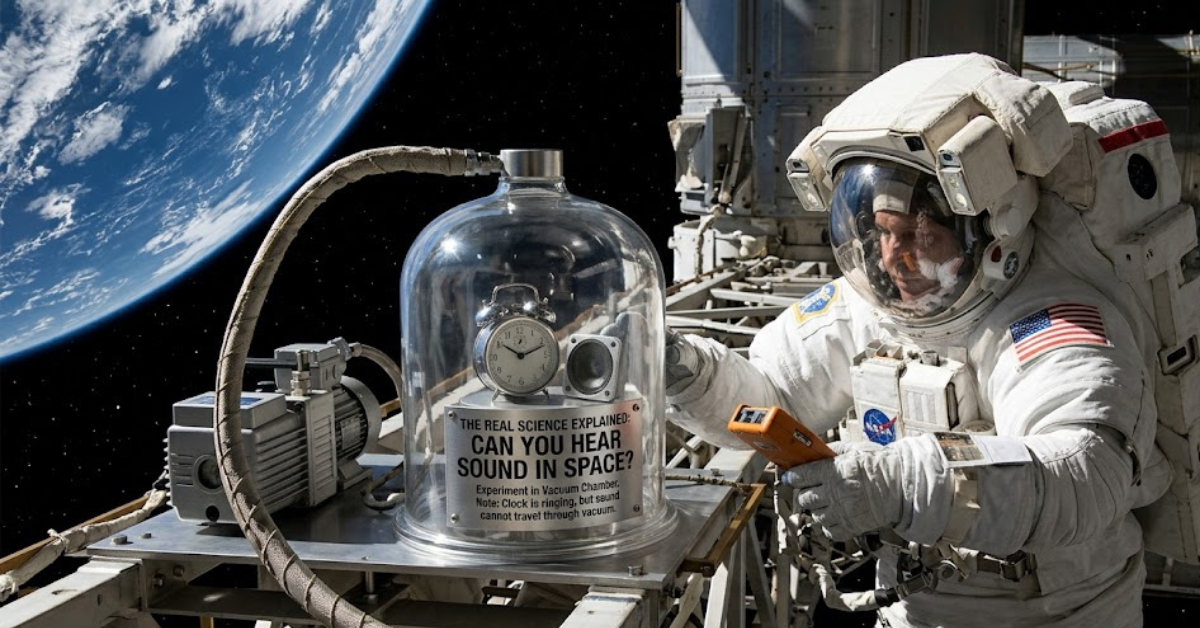

If you’ve ever watched a sci-fi movie, you’ve probably heard giant explosions, roaring spacecraft, and laser blasts echoing dramatically through space. It sounds exciting—but is it scientifically accurate? The question “can you hear sound in space” has fascinated people for decades, and the real answer is more interesting than most movies suggest.
The short answer is no, you usually cannot hear sound in space because space is mostly a vacuum. Sound needs a medium like air, water, or solid material to travel. Since outer space contains extremely few particles, sound waves have almost nothing to move through.
Still, the topic is more complex than a simple yes or no. Scientists, including researchers at NASA, have discovered ways to detect vibrations and convert them into audio humans can hear. So while traditional sound doesn’t travel through space the way it does on Earth, there are some fascinating exceptions and scientific techniques involved.
What Is Sound and How Does It Travel?
To understand can you hear sound in space, you first need to know how sound works.
Sound is created by vibrations. When something vibrates—like a speaker, guitar string, or explosion—it pushes nearby particles back and forth. These vibrations travel in waves through a medium.
Sound can travel through:
- Air
- Water
- Metal
- Glass
- Other gases and solids
But sound cannot travel effectively through empty space because there are not enough particles to carry those vibrations.
For example:
- On Earth, sound moves through the atmosphere.
- Underwater, whales communicate using sound waves.
- Through solids, you can sometimes hear vibrations by placing your ear against a wall.
Without particles, the chain reaction that carries sound simply stops.
Can You Hear Sound in Space Vacuum Conditions?
The phrase “can you hear sound in space vacuum” is one of the most searched versions of this question, and for good reason.
Space is often described as a vacuum, meaning it contains very little matter. Although space is not completely empty, the particles are spread extremely far apart. Because of this, sound waves cannot travel efficiently across large distances.
Imagine shouting in outer space without a helmet. Even if you screamed as loudly as possible:
- Your vocal cords would still create vibrations.
- But there would be no air molecules to carry the sound.
- A nearby astronaut would hear absolutely nothing unless connected through a communication system.
That’s why astronauts rely on radios. Radio waves are electromagnetic signals, not sound waves, so they can travel through the vacuum of space.
Can You Hear Sound in Space? Why or Why Not?
Many people ask, “can you hear sound in space? why or why not?” The scientific reason comes down to the absence of a transmitting medium.
Here’s the simple explanation:
- Sound requires particles to move vibrations.
- Space contains almost no particles.
- Without particles, sound waves cannot travel.
- Therefore, humans cannot naturally hear sound in open space.
This principle is one of the most fundamental concepts in physics and acoustics.
On Earth, sound travels roughly 343 meters per second through air at room temperature. In space, traditional sound propagation effectively breaks down because the environment is too empty.
Why Movies Get Space Sounds Wrong
Hollywood often ignores real science for dramatic effect.
In many films, viewers hear:
- Massive explosions
- Engine roars
- Spaceship flybys
- Laser battles
In reality, these events would occur in near silence if heard from outside the spacecraft.
Directors include sound because silent battle scenes can feel less exciting to audiences. It creates emotional intensity and helps viewers follow the action.
Some films try to be more scientifically accurate by reducing or muting sounds during space scenes. This creates a more realistic experience and highlights how isolated space truly is.
Can Astronauts Hear Anything in Space?
Astronauts can hear sounds inside their spacecraft or spacesuits because air is present there.
Inside a spacecraft, sound behaves similarly to how it does on Earth. Astronauts hear:
- Conversations
- Equipment noises
- Fans and ventilation systems
- Warning alarms
Outside the spacecraft, things change dramatically.
If two astronauts were floating nearby without radios, they would not hear each other speaking through open space. However, sound vibrations can still travel through solid objects.
For example:
- If one astronaut tapped on a metal surface connected to another astronaut, vibrations could potentially travel through the material.
- This is conduction, not sound traveling through empty space itself.
How Can You Hear Sound in Space Through NASA Recordings?
A common question is “how can you hear sound in space” if scientists release recordings from space.
The answer is that these are not ordinary sound recordings captured the way a microphone works on Earth.
Scientists use specialized instruments to detect:
- Plasma waves
- Electromagnetic vibrations
- Radio emissions
- Pressure fluctuations
Those signals are then converted into audio frequencies humans can hear. This process is called sonification.
NASA has released fascinating audio interpretations from:
- Black holes
- Solar storms
- Planetary magnetic fields
- Deep-space plasma waves
These sounds are based on real scientific data, but they are translated into audible form for human understanding.
Can Black Holes Make Sound?
Surprisingly, black holes can be associated with pressure waves in surrounding gas.
In 2022, NASA shared a sonification of a black hole located in the Perseus galaxy cluster. Scientists detected pressure waves moving through hot gas surrounding the black hole.
Technically:
- The vibrations existed in matter around the black hole.
- The frequencies were far too low for human hearing.
- Researchers converted them into audible ranges.
This does not mean humans floating nearby would hear spooky noises directly. Instead, scientists transformed real cosmic data into sound humans can process.
Why Can You Hear Sound in Space in Some Situations?
People sometimes search “why can you hear sound in space” because they hear about radio signals or scientific recordings.
The key detail is that certain regions of space are not completely empty. Some areas contain:
- Gas clouds
- Plasma
- Dust particles
In these environments, vibrations can technically move through matter. However, the density is usually far too low for human ears to detect naturally.
So while sound-like waves can exist in some parts of space, they are not heard the same way sounds are heard on Earth.
What Would Space Actually Sound Like?
If you could magically stand in open space without needing oxygen, the experience would be eerily silent.
You would not hear:
- Explosions
- Engines
- Voices
- Asteroids rushing by
Even nearby activity would appear completely quiet because sound waves could not reach your ears.
Many astronauts describe space visually as overwhelming but acoustically silent outside protected environments.
That silence is one reason space feels mysterious and unsettling to many people.
Common Misconceptions About Sound in Space
There are several myths surrounding this topic.
Myth 1: Space Is Completely Empty
Space contains tiny amounts of gas, dust, and radiation. However, it is still too empty for normal sound transmission.
Myth 2: NASA Records Normal Sounds in Space
Most so-called “space sounds” are converted scientific data rather than direct audio recordings.
Myth 3: Explosions Would Be Loud in Space
Without air or another medium, explosions would not create audible sound waves for nearby listeners.
Myth 4: Humans Could Hear Each Other in Space
Without communication devices or physical contact through materials, human voices would not travel through space.
Can You Hear Sound in Space Give Reason
If someone asks “can you hear sound in space give reason,” here is the simplest scientific answer:
No, you cannot normally hear sound in space because sound requires particles to travel through, and space is mostly a vacuum with too few particles to carry sound waves.
This explanation is widely accepted in physics and astronomy.
What Does NASA Say About Sound in Space?
According to NASA, space is too empty for sound waves to travel the way they do on Earth. NASA explains that planets and stars may produce electromagnetic signals, but humans cannot hear them directly without converting the data into sound.
This scientific approach helps researchers study cosmic activity in new and creative ways.
FAQs
Can you hear sound in space?
No, not in open space. Sound needs particles like air or water to travel, and space is mostly a vacuum.
Can astronauts hear each other in space?
Yes, but only through radios inside their helmets and communication systems.
Why is space silent?
Space is silent because there are too few particles for sound waves to move through.
Can explosions be heard in space?
No. Even large explosions would not produce audible sound in the vacuum of space.
Does NASA record sounds in space?
NASA records electromagnetic waves and vibrations, then converts them into sounds humans can hear.
Can sound travel through a spaceship?
Yes. Inside a spacecraft, air allows sound to travel normally.
Is space completely empty?
Not entirely. Space contains sparse gas, dust, and plasma, but usually not enough for humans to hear sound naturally.
Conclusion
So, can you hear sound in space? In most situations, the answer is no. Because space is largely a vacuum, sound waves cannot travel the way they do on Earth. Without air or another medium, even massive cosmic events would occur in near silence.
However, the universe is not entirely quiet. Scientists can detect vibrations, plasma waves, and electromagnetic signals from distant objects and convert them into audio that humans can experience. That’s why space may seem silent to astronauts but still “sound alive” in scientific research.
Understanding how sound behaves in space gives us a deeper appreciation for physics, astronomy, and the strange beauty of the universe. If you enjoy learning about fascinating science questions like this, exploring related topics about black holes, gravity, and the mysteries of space can open up an entirely new perspective on how the cosmos works.