
Want to build a fuller chest, improve upper-body definition, and increase muscle control? The dumbbell fly is one of the best isolation movements for stretching and contracting the chest through a wide range of motion. Unlike pressing exercises, fly variations emphasize muscle tension rather than pure load.
Whether you’re training at home or in the gym, this movement can be a valuable addition to your chest or shoulder routine. In this guide, you’ll learn proper dumbbell fly form, muscles worked, common mistakes, and the best variations for your goals.
What Is a Dumbbell Fly?
A dumbbell fly is an exercise where you move two dumbbells in a wide arc while keeping a slight bend in the elbows. The motion brings the arms together using the chest or rear shoulder muscles depending on the variation.
Because the movement limits triceps involvement, it allows more direct focus on the target muscles.
Main Benefits
- Improves chest isolation
- Builds upper-body symmetry
- Enhances muscle stretch under tension
- Supports better mind-muscle connection
- Adds variety to pressing workouts
- Can be adjusted for chest or rear shoulders
Dumbbell Fly Muscles Worked
The muscles trained depend on the version you perform.
Chest-Focused Variations
- Pectoralis major
- Front deltoids
- Serratus anterior
- Stabilizing biceps and forearms
Rear Shoulder Variations
- Rear deltoids
- Rhomboids
- Trapezius
- Upper back stabilizers
For many lifters, understanding dumbbell fly muscles worked helps choose the right angle and setup.
How to Perform Proper Dumbbell Fly Form
Technique matters because poor control can stress the shoulders.
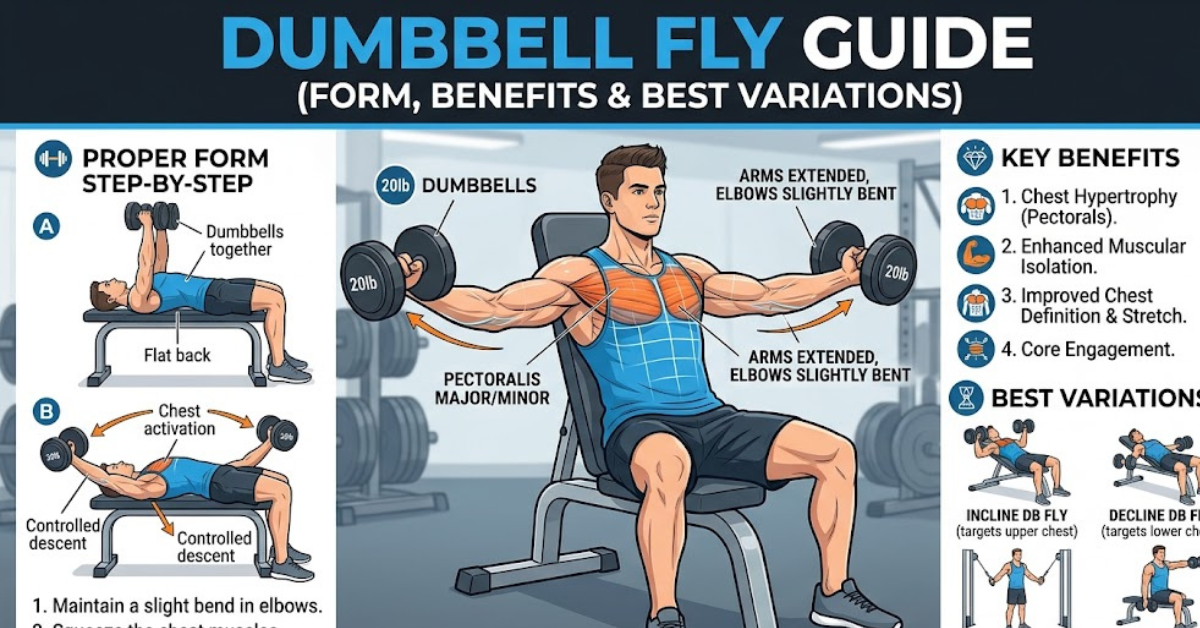
Flat Dumbbell Fly
- Lie on a flat bench holding dumbbells above the chest.
- Keep a soft bend in the elbows.
- Lower the weights out wide in a controlled arc.
- Stop when you feel a chest stretch.
- Bring the weights back together using the chest.
- Repeat smoothly without clanging dumbbells together.
Key Form Tips
- Keep shoulders packed down
- Avoid locking elbows
- Move slowly on the lowering phase
- Use moderate weight
- Focus on squeezing the chest at the top
Best Dumbbell Fly Variations
Incline
Performed on an incline bench, this variation targets the upper chest more directly.
Best for: Building upper-pec fullness and clavicular chest development.
Flat Bench
The classic version performed on a flat bench.
Best for: Overall chest stretch and balanced pec development.
Decline
Done on a decline bench to shift emphasis lower on the chest.
Best for: Lower chest focus and training variety.
Reverse
This movement targets the rear shoulders and upper back instead of the chest.
Best for: Shoulder balance and posture.
Bent Over Reverse
Hinge at the hips and raise dumbbells outward to the sides.
Best for: Rear delt strength and upper-back activation.
Rear Delt
Often done seated, bent over, or chest-supported.
Best for: Developing the back side of the shoulders.
Floor
Performed lying on the floor, limiting range of motion.
Best for: Beginners or people with shoulder discomfort.
Standing
Usually done as a chest squeeze motion or front arc movement while standing.
Best for: Home workouts and lighter accessory training.
Common Dumbbell Fly Mistakes
Using Too Much Weight
Heavy dumbbells often turn the exercise into a press and reduce chest tension.
Straight Arms
Locked elbows can stress the joints. Keep a slight bend throughout.
Dropping Too Low
Only lower as far as shoulder mobility allows.
Fast Reps
Momentum reduces muscle engagement and increases injury risk.
Poor Shoulder Position
Keep shoulder blades stable rather than shrugging upward.
Dumbbell Fly vs Bench Press
| Feature | Dumbbell-Fly | Bench Press |
| Main Goal | Isolation | Strength & Mass |
| Triceps Involvement | Low | High |
| Range of Motion | Large stretch | Moderate |
| Weight Used | Moderate | Heavy |
| Skill Demand | Moderate | Moderate |
Both movements work well together in a chest routine.
Dumbbell Fly Alternative Exercises
If you need a dumbbell-fly alternative, try these:
- Cable fly
- Pec deck machine
- Resistance band fly
- Push-ups
- Chest press machine
- Ring fly progression
These options offer similar chest tension with different resistance curves.
How to Program Dumbbell Fly in Your Workout
Use fly movements after pressing exercises when the chest is already warm.
Beginners
- 2–3 sets of 12–15 reps
Intermediate
- 3–4 sets of 10–12 reps
Advanced
- 4 sets of 8–15 reps with slow tempo and pauses
Train once or twice weekly depending on total chest volume.
Is Incline Dumbbell Fly Worth Doing?
Yes. The incline dumbbell fly exercise is excellent for lifters who want more upper-chest emphasis. Many people struggle to develop that area using flat pressing alone, so incline fly work can help.
FAQ About
What muscles does a dumbbell fly work?
Primarily the chest, with help from the front shoulders and stabilizers. Reverse versions focus on rear delts and upper back.
Is dumbbell fly better than bench press?
They serve different purposes. Flys isolate the chest while bench press builds overall pushing strength.
How heavy should dumbbell fly be?
Use a manageable load that allows control and full tension. This is not usually a max-strength exercise.
Can beginners do dumbbell fly?
Yes, especially with light weights or the floor variation.
Are reverse flys good for posture?
Yes. They strengthen rear shoulders and upper back muscles that support better alignment.
How often should I train flys?
One to two times weekly is enough for most people.
Conclusion
The dumbbell-fly is a powerful exercise for building chest shape, improving muscle control, and adding variety to your upper-body training. Whether you choose the incline dumbbell-fly, flat dumbbell-fly, or reverse dumbbell fly, the key is smart technique and controlled reps.
Use moderate weight, focus on tension, and combine fly movements with pressing exercises for the best results. Add this movement to your routine and enjoy stronger, better-developed chest and shoulders.