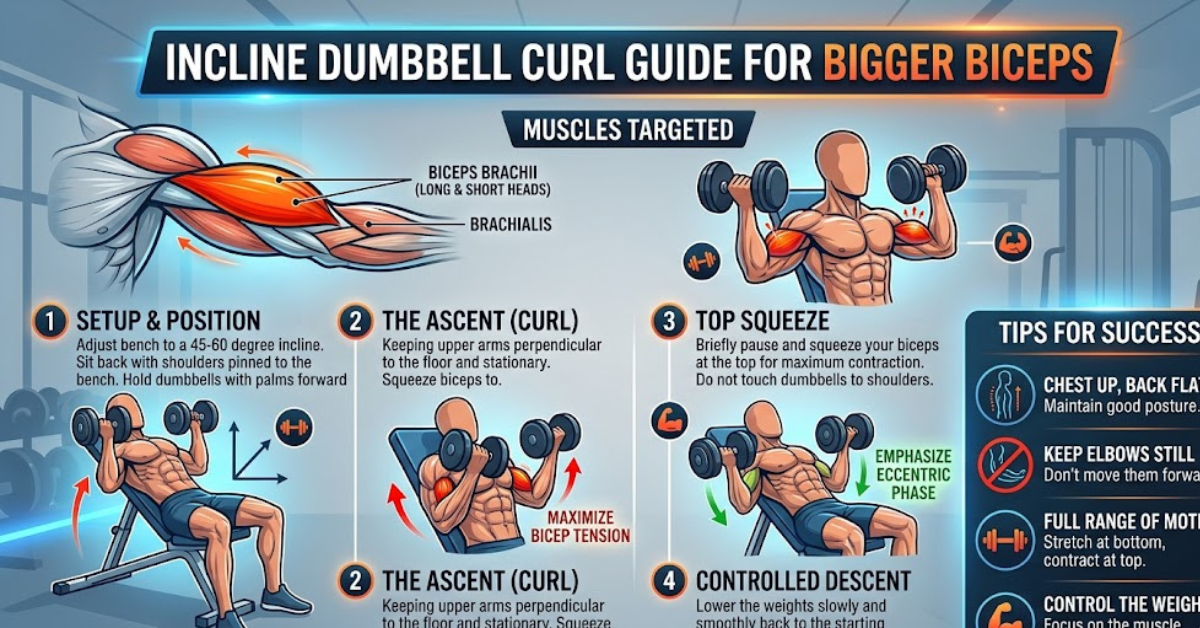

If regular curls have stopped delivering results, the incline dumbbell curl might be the missing piece in your arm routine. This simple but highly effective movement places your arms behind your torso, creating a deeper stretch and stronger contraction through the biceps.
Because of that unique position, many lifters use it to build fuller arms and improve peak development. In this guide, you’ll learn the best setup, proper technique, ideal bench angle, muscles worked, common mistakes, and the smartest ways to add it to your training.
What Is an Incline Dumbbell Curl?
The incline dumbbell curl is a seated biceps exercise performed on an adjustable bench set to an incline. You sit back with your arms hanging naturally toward the floor and curl the dumbbells upward while keeping your elbows behind the body.
This setup changes the resistance profile compared to standing curls, making the exercise especially effective for targeting the long head of the biceps.
Why This Exercise Works So Well
Many curls start with the arms at your sides. In contrast, the incline position lengthens the biceps before each rep, increasing tension from the bottom of the movement.
Key Benefits
- Greater stretch for the biceps
- Excellent isolation with minimal cheating
- Helps improve arm symmetry
- Builds fuller-looking upper arms
- Easy to adjust for beginners or advanced lifters
- Pairs well with hammer curls and preacher curls
Incline Dumbbell Curl Muscles Worked
This exercise primarily targets the front of the upper arm, but several muscles assist.
Primary Muscles
- Biceps brachii – Main curling muscle
- Long head of the biceps – Often emphasized due to shoulder position
- Brachialis – Lies under the biceps and adds arm thickness
Secondary Muscles
- Forearms
- Wrist stabilizers
- Front delts (light stabilization)
How to Do Proper Incline Dumbbell Curl Form
Technique matters more than swinging heavy weights. Follow these steps carefully.
Setup
- Adjust a bench to about 45–60 degrees.
- Sit back fully with your shoulders against the pad.
- Hold dumbbells with palms facing forward.
- Let arms hang straight down.
Execution
- Keep elbows fixed slightly behind your torso.
- Curl both dumbbells upward with control.
- Squeeze the biceps near the top.
- Lower slowly until arms are fully extended.
- Repeat for the planned reps.
Form Tips
- Keep shoulders pinned back
- Do not swing the torso
- Use a slow lowering phase
- Avoid moving elbows forward too early
- Control every rep
Best Angle for Incline Dumbbell Curl
One of the most common questions is: what angle for incline dumbbell curl works best?
For most people, a bench set between 45 and 60 degrees offers the best balance of stretch and comfort.
Bench Angle Breakdown
- 30–45 degrees: More stretch, harder at the bottom
- 45–60 degrees: Best all-around choice
- 60–75 degrees: Easier on shoulders, slightly less stretch
If shoulder mobility is limited, start higher and lower the angle gradually over time.
Seated Incline Dumbbell Curl vs Standing Curl
Both are effective, but they emphasize different benefits.
| Exercise | Main Advantage | Best For |
| Seated incline version | Deep stretch and strict form | Hypertrophy |
| Standing curl | Heavier loading | Strength |
| Alternating standing curl | Focused side-to-side work | Symmetry |
Many lifters benefit from using both in the same weekly program.
Common Mistakes to Avoid
1. Using Too Much Weight
Heavy dumbbells often lead to swinging and poor elbow position.
2. Raising Elbows Forward
This shifts tension away from the biceps.
3. Shortening the Range of Motion
Use full extension at the bottom when pain-free.
4. Rushing Reps
Slower reps create better tension and safer mechanics.
5. Wrong Bench Setup
A poor incline dumbbell curl bench angle can reduce effectiveness or irritate shoulders.
Incline Dumbbell Curl Alternative Exercises
If no adjustable bench is available or you want variety, try these options:
- Standing dumbbell curls
- Preacher curls
- Cable curls
- Spider curls
- Hammer curls
- Resistance band curls
These movements can complement or replace the incline setup depending on equipment access.
Programming for Best Results
For muscle growth, place curls after compound pulling exercises.
Beginners
- 3 sets of 10–12 reps
Intermediate
- 3–4 sets of 8–12 reps
Advanced
- 4 sets of 8–15 reps with controlled tempo
Train arms 1–2 times weekly for consistent progress.
Who Should Use This Exercise?
The incline dumbbell curl exercise is ideal for:
- Lifters wanting bigger biceps
- People stuck on standard curls
- Anyone needing stricter arm training
- Home gym users with bench and dumbbells
- Intermediate trainees seeking variety
FAQ About Incline Dumbbell Curl
Is the incline dumbbell curl better than regular curls?
It depends on your goal. Incline curls create more stretch and isolation, while standing curls allow heavier loading.
What is the best angle for incline dumbbell curl?
Most people do best between 45 and 60 degrees.
How many reps should I do?
For growth, 8–15 reps with good control works very well.
Can beginners do this movement?
Yes. Start light, focus on form, and use a comfortable bench angle.
Why do my shoulders feel it more than my biceps?
Your bench angle may be too low, or you may be moving elbows forward during reps.
Is this exercise good for arm size?
Absolutely. It’s one of the best curl variations for targeting the biceps through a long range of motion.
Conclusion
The incline dumbbell curl is one of the smartest exercises for building stronger, fuller biceps. Its stretched starting position, strict movement path, and strong contraction make it a favorite among beginners and experienced lifters alike.
Use a proper bench angle, control each rep, and stay consistent. Add this movement to your next arm workout and you may quickly notice better pumps, stronger curls, and more visible arm development.