
Want a stronger back, better posture, and more upper-body pulling power? Dumbbell rows are one of the most effective exercises you can add to your routine. They build muscle through the back, improve shoulder stability, and help balance strength between both sides of the body.
Whether you train at home or in the gym, rows with dumbbells are versatile, beginner-friendly, and easy to progress. In this guide, you’ll learn how to do dumbbell rows, the muscles they target, common mistakes, and the best variations for results.
What Are Dumbbell Rows?
Dumbbell rows are resistance exercises where you pull one or two dumbbells toward your torso while keeping the spine stable. They are designed to train the muscles of the upper and mid-back while also involving the arms and core.
Because they can be performed in several positions, they fit nearly every fitness level and equipment setup.
Why They’re So Effective
- Build back thickness and width
- Improve posture and shoulder control
- Strengthen grip and forearms
- Correct left-to-right imbalances
- Support pull-ups and deadlifts
- Work well in home workouts
What Do Dumbbell Rows Work?
Many people ask, what do dumbbell rows work? The answer is several major upper-body muscles.
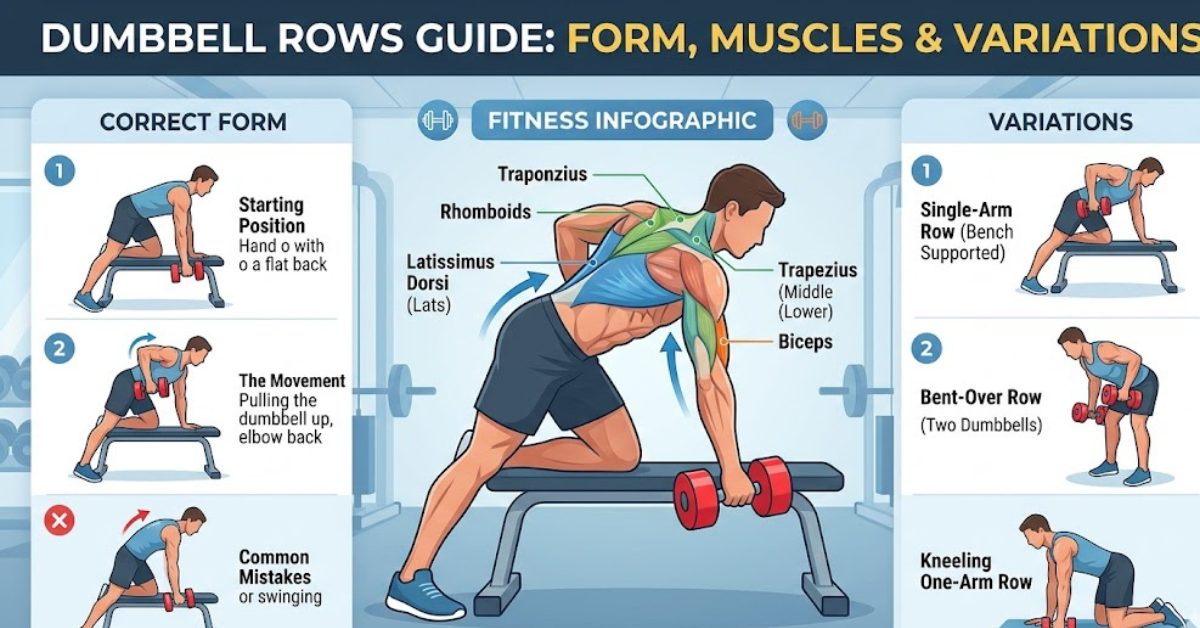
Primary Muscles Targeted
- Latissimus dorsi (lats)
- Rhomboids
- Trapezius
- Rear deltoids
Secondary Muscles
- Biceps
- Forearms
- Core stabilizers
- Lower back (during unsupported versions)
If you’ve wondered what muscles do dumbbell rows work, think of them as a complete pulling movement for the back and arms.
How to Do Dumbbell Rows Correctly
Proper dumbbell rows form matters more than lifting heavy. Strong technique helps you target the right muscles and avoid unnecessary strain.
Single Arm Dumbbell Rows
- Place one hand and one knee on a bench.
- Keep your back flat and core tight.
- Hold the weight in the free hand.
- Pull the dumbbell toward your hip.
- Pause briefly at the top.
- Lower under control.
- Repeat on the other side.
Key Technique Tips
- Keep shoulders square
- Avoid twisting the torso
- Pull with the elbow
- Keep neck neutral
- Control the lowering phase
Best Dumbbell Rows Variations
Changing angles and body position can emphasize different muscles.
Bent Over Dumbbell Rows
Stand hinged at the hips with a dumbbell in each hand and row both weights upward.
Best for: Overall back strength and mass.
Bent-Over Dumbbell Rows With Neutral Grip
Using palms facing inward can feel easier on the shoulders.
Best for: Comfortable heavy rowing.
Chest-Supported Dumbbell Rows
Lie chest-down on an incline bench and pull the weights upward.
Best for: Reducing lower-back stress and isolating the upper back.
Incline Dumbbell Rows
Use a low incline bench for a controlled rowing angle.
Best for: Strict form and muscle growth.
Dumbbell Rows on Bench
Classic supported rows with one hand braced on a bench.
Best for: Beginners and unilateral training.
Seated Dumbbell Rows
Performed seated and hinged slightly forward.
Best for: Home workouts with limited space.
Renegade Dumbbell Rows
Start in a plank position and row one dumbbell at a time.
Best for: Core strength plus upper-body endurance.
Barbell or Dumbbell Rows: Which Is Better?
Both are excellent, but each has strengths.
| Feature | Dumbbells | Barbell |
| Unilateral Training | Yes | No |
| Range of Motion | Greater | Moderate |
| Core Demand | Moderate | High |
| Load Potential | Moderate | High |
| Joint Friendliness | Often Better | Depends |
Choose based on goals, comfort, and available equipment.
Common Dumbbell Rows Mistakes
Even great exercises can lose effectiveness with poor execution.
1. Rounding the Back
Maintain a neutral spine throughout the movement.
2. Pulling Too High
Bring the elbow toward the hip or ribs, not the neck.
3. Using Momentum
Swinging the torso shifts tension away from the back.
4. Shrugging the Shoulders
Keep shoulders down and stable.
5. Going Too Heavy
Use a load you can control with full range of motion.
How to Add Dumbbell Rows to Your Routine
For strength and muscle gain:
Beginners
- 3 sets of 10–12 reps
Intermediate
- 4 sets of 8–10 reps
Advanced
- 4–5 sets of 6–12 reps
Pair them with presses, pull-ups, and lower-body work for a complete plan.
Dumbbell Rows Muscles Worked for Posture
Rows don’t just build size. They strengthen the muscles that pull the shoulders back and support better alignment. If you sit often or work at a desk, this can be especially valuable.
FAQs
How often should I do dumbbell rows?
Two to three times per week works well for most people, depending on total training volume.
Are single arm dumbbell rows better than two-arm rows?
Single-arm versions help fix imbalances and improve focus, while two-arm rows allow faster training and heavier total loading.
Can beginners do dumbbell rows?
Yes. Supported bench rows are ideal for learning proper mechanics.
Do dumbbell rows grow the lats?
Absolutely. Rows are one of the best exercises for developing the lats and mid-back.
Should I choose chest supported dumbbell rows?
They’re a great option if your lower back gets fatigued or you want stricter form.
Are renegade dumbbell rows effective?
Yes, especially for combining back training with core stability.
Conclusion
Dumbbell rows are one of the smartest exercises for building a stronger, more muscular back while improving posture and pulling strength. From bent over dumbbell rows to chest-supported dumbbell rows, there’s a variation for every goal and fitness level.
Focus on clean technique, progressive overload, and consistency. Add rows to your routine and you’ll notice stronger lifts, better posture, and a more athletic upper body over time.