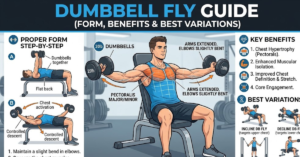
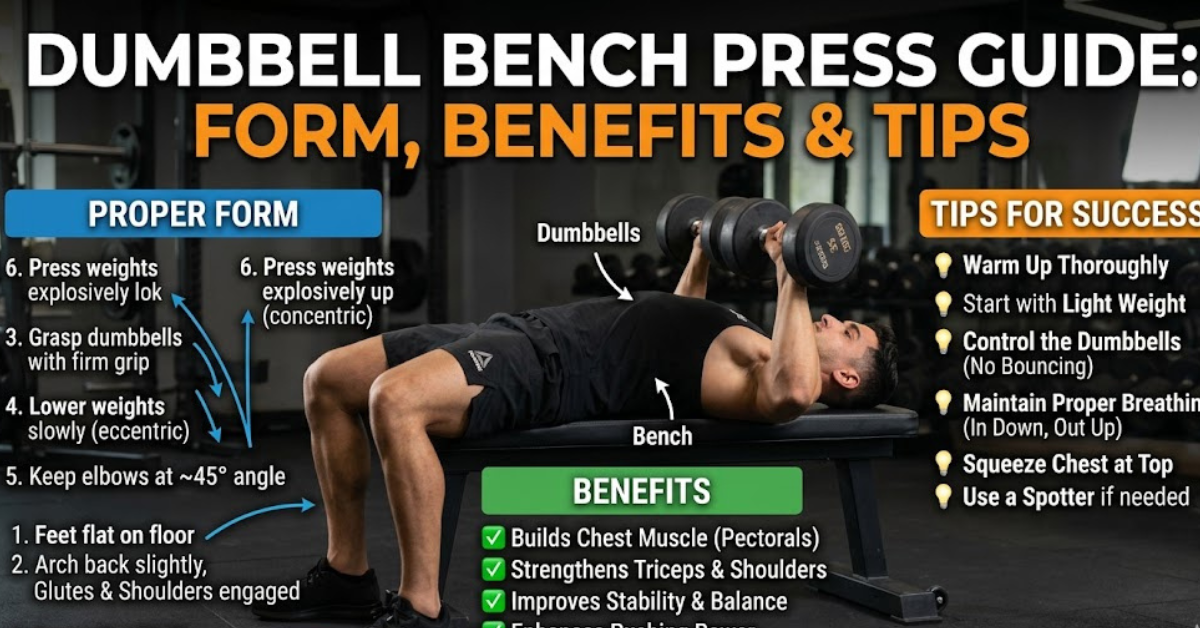

Want a bigger chest, stronger arms, and better pressing power? The dumbbell bench press is one of the best exercises for building upper-body strength while improving muscle balance and joint stability. Unlike machines or fixed bars, dumbbells force each arm to work independently, making every rep more effective.
Whether you train at home or in a commercial gym, this movement belongs in almost every chest workout. In this guide, you’ll learn proper technique, key benefits, common mistakes, and the best variations to maximize results.
What Is the Dumbbell Bench Press?
The dumbbell bench press is a free-weight pressing exercise performed while lying on a bench and pressing two dumbbells upward from chest level. It targets the chest, shoulders, and triceps while requiring more stabilization than a barbell press.
Because each arm moves independently, it can help correct strength imbalances and improve overall coordination.
Dumbbell Bench Press Muscles Worked
This exercise activates several upper-body muscles at once.
Primary Muscles
- Pectoralis major (chest)
- Anterior deltoids (front shoulders)
- Triceps brachii
Secondary Muscles
- Serratus anterior
- Rotator cuff stabilizers
- Core muscles for control
- Forearms and grip muscles
If you’re wondering what does dumbbell bench press work, it mainly develops pressing strength and chest size while supporting shoulder stability.
Benefits of the Dumbbell Bench Press
Greater Range of Motion
Dumbbells allow your arms to move deeper than a barbell, which can increase chest activation.
Better Muscle Balance
Each side works on its own, reducing the chance of one side compensating for the other.
Joint-Friendly Pressing
Many lifters find dumbbells more comfortable on the shoulders and wrists.
Functional Strength
The added stabilization carries over well to sports and daily movement.
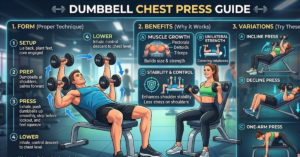
How to Do Dumbbell Bench Press Properly
Learning how to do dumbbell bench press correctly is the fastest path to results.
Step-by-Step Technique
- Sit on the bench with dumbbells resting on your thighs.
- Lie back while bringing the weights to chest level.
- Plant feet firmly on the floor.
- Keep shoulder blades pulled back and chest lifted.
- Press the dumbbells upward until arms are nearly straight.
- Lower slowly until elbows are slightly below bench level.
- Repeat with control.
Dumbbell Bench Press Proper Form Tips
- Keep wrists straight
- Do not bounce weights off the chest
- Avoid flaring elbows too wide
- Keep feet grounded throughout the set
- Move through a controlled range of motion
Mastering dumbbell bench press form matters more than lifting heavy.
Best Dumbbell Bench Press Variations
Changing bench angle can target different areas of the chest.
Flat Dumbbell Bench Press
The classic version performed on a flat bench.
Best for: Overall chest development and pressing strength.
Incline Dumbbell Bench Press
Bench set at 30–45 degrees.
Best for: Upper chest and front shoulders.
Decline Dumbbell Bench Press
Bench angled downward.
Best for: Lower chest emphasis.
Close Grip Dumbbell Bench Press
Keep dumbbells closer together and elbows tucked.
Best for: Triceps and inner pressing mechanics.
Barbell vs Dumbbell Bench Press
Many lifters compare barbell vs dumbbell bench press when planning workouts.
| Feature | Dumbbells | Barbell |
| Range of Motion | Greater | Moderate |
| Stability Demand | Higher | Lower |
| Max Strength Potential | Moderate | Higher |
| Muscle Balance | Excellent | Moderate |
| Shoulder Comfort | Often Better | Varies |
If your goal is maximum powerlifting strength, barbells shine. For balanced muscle growth and joint-friendly training, dumbbells are excellent.
Common Mistakes to Avoid
Going Too Heavy
Weights that are too heavy often lead to poor control and shoulder stress.
Flaring Elbows
This can reduce pressing efficiency and irritate shoulders.
Partial Reps
Use a full range of motion unless limited by injury.
Rushing the Tempo
Lowering the weights slowly increases tension and control.
How to Program the Exercise
Use the dumbbell bench press exercise 1–3 times per week depending on your split.
Muscle Growth
- 3–4 sets
- 8–12 reps
Strength
- 4–5 sets
- 4–8 reps
Beginners
- 3 sets
- 10 reps with manageable weight
Pair it with rows, shoulder presses, and push-ups for a complete upper-body routine.
Dumbbell Bench Press at Home or Gym
The dumbbell bench press gym setup is ideal because benches and heavier weights are available. At home, adjustable dumbbells and a sturdy bench can provide nearly the same benefits.
If no bench is available, floor presses are a strong alternative.
FAQ About Dumbbell Bench Press
Is dumbbell bench press better than barbell bench press?
It depends on your goal. Dumbbells improve balance, range of motion, and joint comfort, while barbells are better for maximal strength.
How heavy should I start?
Choose a weight you can control for 8–12 clean reps with proper technique.
Is incline dumbbell bench press necessary?
Not mandatory, but it’s excellent for upper chest development and variety.
Can beginners do this exercise?
Yes. It’s beginner-friendly when started with light weights and proper form.
How often should I do dumbbell bench press?
Most people do well with 1–3 weekly sessions depending on recovery and training volume.
What if I don’t have a bench?
Use a floor press variation or resistance bands until a bench is available.
Conclusion
The dumbbell bench press remains one of the most effective exercises for building chest size, pressing strength, and balanced upper-body development. It offers a greater range of motion, trains stabilizer muscles, and can be easier on the joints than barbell pressing.
Start with manageable weights, focus on excellent form, and progress gradually. Whether you choose the flat version, incline dumbbell bench press, or decline setup, consistent training will deliver stronger presses and a more muscular physique.