
If you want a stronger chest, better pressing power, and balanced upper-body development, the dumbbell chest press is one of the smartest exercises you can add to your workouts. It builds strength through a natural range of motion while helping each side of the body work independently.
Unlike a barbell press, dumbbells allow greater movement freedom, making them a favorite for both beginners and experienced lifters. In this guide, you’ll learn correct technique, muscles worked, top variations, and how to get better results from every rep.
What Is the Dumbbell Chest Press?
The dumbbell chest press is a pushing exercise where you lie on a bench or floor and press dumbbells upward from chest level until your arms are extended. It primarily targets the chest muscles while also training the shoulders and triceps.
Because each arm controls its own weight, the exercise improves coordination and helps correct strength imbalances.
Why It’s So Effective
- Builds chest strength and size
- Improves shoulder stability
- Increases pressing power
- Allows natural wrist movement
- Helps balance left and right sides
- Works well in home or gym workouts
Dumbbell Chest Press Muscles Worked
This movement trains multiple upper-body muscles at once.
Primary Muscles
- Pectoralis major – Main chest muscle responsible for pressing
- Anterior deltoids – Front shoulders assist the lift
- Triceps – Extend the elbows during the press
Secondary Muscles
- Serratus anterior
- Rotator cuff stabilizers
- Core muscles for control
That combination makes it one of the best compound movements for upper-body strength.
How to Do Proper Dumbbell Chest Press Form
Technique matters more than weight. Use these steps for safe, efficient reps.
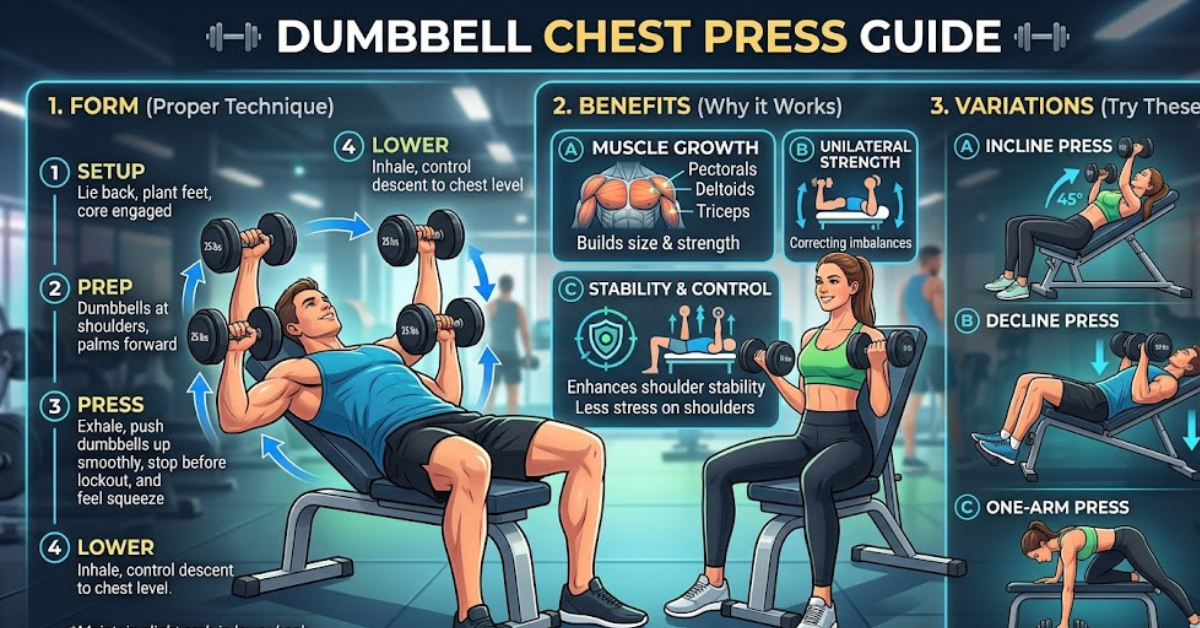
Dumbbell Chest Press on Bench
- Sit on a flat bench holding dumbbells on your thighs.
- Lie back and bring the weights beside your chest.
- Keep feet planted firmly on the floor.
- Press the dumbbells upward until arms are nearly straight.
- Lower slowly until elbows are slightly below bench level.
- Repeat with control.
Form Tips
- Keep shoulder blades pulled back
- Maintain a slight natural arch in the lower back
- Wrists stacked over elbows
- Avoid bouncing at the bottom
- Control both the lift and lowering phase
Best Dumbbell Chest Press Variations
Changing angle or setup can shift muscle emphasis and keep training fresh.
Flat Dumbbell Chest Press
Performed on a flat bench for overall chest development.
Best for: Balanced chest size and pressing strength.
Incline Dumbbell Chest Press
Use a bench angled around 30–45 degrees.
Best for: Upper chest and front shoulders.
Floor Dumbbell Chest Press
Also known as the dumbbell chest press on floor, this limits shoulder range of motion.
Best for: Home workouts and shoulder-friendly pressing.
Single Arm Dumbbell Chest Press
Press one dumbbell at a time while keeping the body stable.
Best for: Core engagement and fixing imbalances.
Single Dumbbell Chest Press
Use one dumbbell held with both hands or alternate one side at a time.
Best for: Beginners or limited equipment setups.
Standing Dumbbell Chest Press
Usually performed with a slight forward push pattern.
Best for: Functional pressing and core control.
Dumbbell Chest Press vs Barbell Bench Press
| Feature | Dumbbell Press | Barbell Press |
| Range of Motion | Greater | Moderate |
| Muscle Balance | Excellent | Limited |
| Stability Demand | Higher | Lower |
| Max Load Potential | Moderate | Higher |
| Joint Comfort | Often Better | Depends on form |
Both exercises work well, but dumbbells are excellent for balanced muscle development and shoulder-friendly pressing.
Common Mistakes to Avoid
1. Flaring Elbows Too Wide
Keep elbows slightly tucked to reduce shoulder stress.
2. Rushing Reps
Fast reps reduce tension and control.
3. Going Too Heavy
Choose a weight you can control through full range.
4. Poor Shoulder Position
Keep shoulder blades stable throughout the set.
5. Uneven Pressing
Press both dumbbells evenly to avoid imbalance.
How to Program the Dumbbell Chest Press
Use it once to three times per week depending on your training split.
Beginners
- 3 sets of 10–12 reps
Intermediate
- 4 sets of 8–10 reps
Advanced
- 4–5 sets of 6–12 reps using progressive overload
Pair it with rows, shoulder presses, and push-ups for complete upper-body development.
Is the Floor Version Effective?
Yes. The dumbbell chest press floor variation is highly effective, especially for people training at home. Since elbows stop at the floor, it can feel safer on the shoulders while still building pressing strength.
It’s also great for learning control and improving lockout power.
Can Beginners Do This Exercise?
Absolutely. It’s one of the best beginner pressing movements because each arm learns to stabilize independently. Start with light weights and focus on movement quality before chasing heavier loads.
FAQ About Dumbbell Chest Press
Is dumbbell chest press better than bench press?
Neither is universally better. Dumbbells offer more range of motion and balance training, while barbells allow heavier loading.
What muscles does it work most?
Mainly the chest, front shoulders, and triceps.
Should I choose incline or flat?
Use flat for overall development and incline for upper chest emphasis. Many lifters use both.
Is floor pressing good for shoulders?
Yes, many people find it more comfortable because the reduced range limits deep shoulder stretch.
How heavy should I go?
Use a weight that challenges you while allowing full control and clean technique.
Can I do it without a bench?
Yes, the floor version works very well if no bench is available.
Conclusion
The dumbbell chest press is one of the most effective exercises for building chest strength, improving muscular balance, and developing safer pressing mechanics. Whether you prefer a flat bench setup, incline dumbbell chest press, or floor version, consistent practice with proper form delivers results.
Start with a manageable weight, focus on control, and gradually progress. Add this movement to your routine and you’ll build a stronger, more defined upper body over time.