
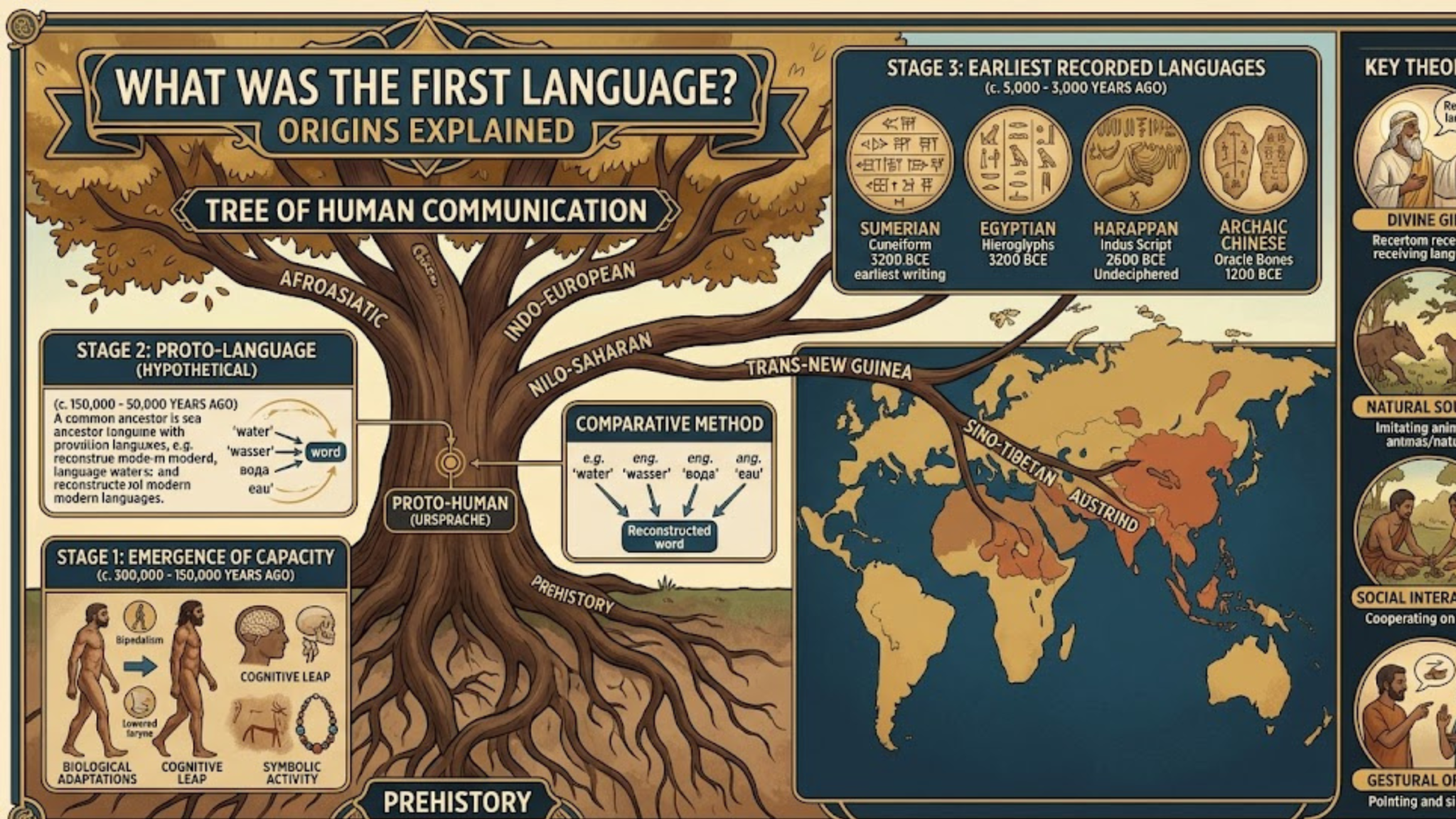

People have asked the same question for centuries: what was the first language? Humans speak thousands of languages today, yet no one can point to the exact first one. That mystery makes the topic so fascinating.
The answer is more complex than it seems. Humans began speaking long before they started writing. Because speech leaves no physical record, researchers must rely on clues from archaeology, migration patterns, and language development. In this article, we’ll look at what experts know, what remains uncertain, and the strongest theories about early human communication.
Why No One Knows the First Language
The biggest challenge is simple: people spoke long before they wrote anything down.
Early humans likely used spoken communication for tens of thousands of years before written symbols appeared. Since no recordings or direct evidence exist, scholars cannot identify one confirmed original language.
Main Reasons the Mystery Remains
- Writing began only about 5,000 years ago
- Human speech may be more than 100,000 years old
- Languages change constantly over time
- Older languages split into newer ones
- No one recorded the earliest conversations
Because of this, experts study patterns instead of naming a single first language.
When Did Humans Start Speaking?
Scientists believe language developed gradually. It did not appear in one sudden moment.
Instead, human communication likely evolved through gestures, sounds, and simple signals before becoming structured speech.
Estimated Timeline
- 2 million years ago – Early ancestors used sounds and gestures
- 200,000 years ago – Modern humans appeared
- 100,000+ years ago – Complex speech may have developed
- 5,000 years ago – Written records began
So rather than asking for one exact first language, it may be better to ask when speech became advanced enough to resemble language as we know it.
The Oldest Written Languages Known Today
Although no one knows the first spoken tongue, historians know several of the oldest written languages.
1. Sumerian
People in ancient Mesopotamia used Sumerian. It appears on cuneiform tablets from around 3200 BCE.
2. Egyptian
Ancient Egyptians created one of the earliest writing systems through hieroglyphics.
3. Akkadian
Akkadian later became a major language in Mesopotamia and replaced Sumerian in many regions.
4. Elamite and Others
Other early languages also appeared in nearby civilizations.
These examples represent the oldest written evidence, not necessarily the first speech humans used.
Did All Languages Come From One Source?
Some researchers support the idea of a “Proto-World” language. This theory suggests all languages may trace back to one ancient ancestor.
Why Some Experts Consider It Possible
- All humans share common ancestry
- Languages often evolve from earlier forms
- Certain sound patterns appear worldwide
Why It Remains Unproven
- Too much time has passed
- Evidence is limited
- Similarities may happen by chance
The theory remains interesting, but no one has proven it.
What Was the First Language of the Bible?
Many people ask about the earliest biblical languages. The answer depends on which section you mean.
Old Testament
Most of the Hebrew Bible was written in Hebrew, with some parts in Aramaic.
New Testament
Writers composed the New Testament mainly in Koine Greek.
So the Bible did not begin in one single language.
What Was the First Language in America?
Before English, Spanish, or French arrived, Indigenous peoples across the Americas already spoke hundreds of languages.
Examples of Early Native Languages
- Nahuatl
- Quechua
- Cherokee
- Navajo
- Algonquian languages
- Inuit languages
These native languages existed for thousands of years before European colonization.
What Experts Agree On Today
Most linguists agree on three key points:
1. Language Developed Slowly
Speech likely evolved across many generations.
2. Speaking Came Before Writing
Humans communicated orally long before they used writing systems.
3. Many Early Languages Disappeared
Thousands of ancient languages vanished without records.
That is why no one can identify the first language with certainty.
Common Myths About Language Origins
Myth 1: Sumerian Was the First Spoken Language
Sumerian is one of the earliest written languages, but not proven first spoken.
Myth 2: Hebrew Was Humanity’s Original Language
Some traditions believe this, but scholars have not confirmed it.
Myth 3: English Is an Ancient Original Language
English developed much later from Germanic roots.
Why This Question Still Matters
Asking about the first language is really asking how humans became social, creative beings. Language helped people:
- Share ideas
- Build communities
- Teach children
- Preserve stories
- Create culture
Speech transformed human history.
FAQs
What was the first language ever spoken?
No one knows for sure because speech began before writing.
What was the first language in the world?
There is no confirmed answer. Many early spoken languages likely existed.
What was the first written language?
Sumerian ranks among the earliest known written languages.
What language was the Bible first written in?
The Old Testament was mostly Hebrew, while the New Testament used Greek.
What language did Native Americans speak first?
Different Indigenous groups spoke many languages across the Americas.
Did humans once share one language?
Possibly, but researchers have not proven it.
Conclusion
So, what was the first language? The honest answer is that no one knows. Human speech likely developed slowly long before written history began. Ancient languages such as Sumerian and Egyptian offer valuable clues, but they do not reveal the first spoken words.
The mystery of language origins shows just how powerful communication is. If you enjoy topics like this, explore more about ancient civilizations, linguistics, and early human history.