
Few exercises have stayed relevant for decades like the dumbbell pullover. It looks simple, but when done correctly, it can challenge your chest, lats, shoulders, and core in one smooth movement. That combination makes it a favorite for lifters who want more upper-body strength and better mobility.
Whether your goal is a bigger chest, stronger back, or improved shoulder range of motion, this movement deserves attention. In this guide, you’ll learn proper technique, the dumbbell pullover muscles worked, key benefits, common mistakes, and the best variations to try.
What Is a Dumbbell Pullover?
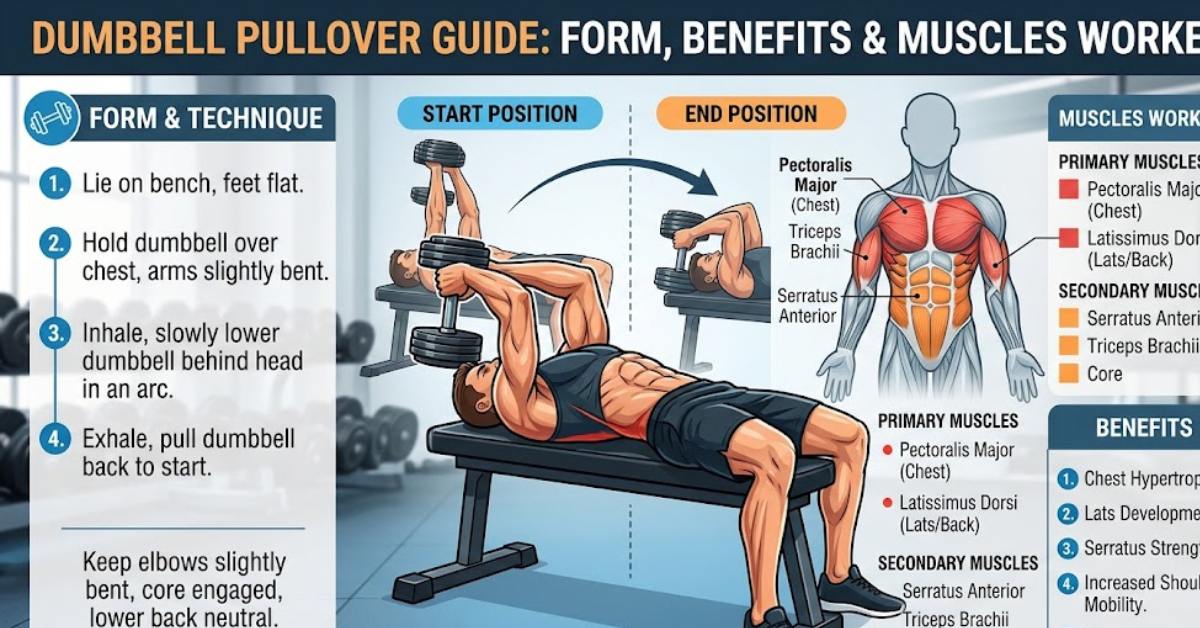
A dumbbell pullover is performed lying on a bench or floor while holding one dumbbell with both hands. You lower the weight behind your head with mostly straight arms, then pull it back over your chest.
The movement blends shoulder extension with upper-body control, making it unique compared to presses or rows.
Why It’s Popular
- Targets multiple upper-body muscles
- Builds chest and back together
- Improves shoulder mobility
- Requires only one dumbbell
- Works well in home or gym workouts
Dumbbell Pullover Muscles Worked
Many people ask, what does dumbbell pullover work? The answer depends slightly on your form and setup, but several muscles are involved.
Primary Muscles
- Latissimus dorsi (lats) – Main pulling muscle of the back
- Pectoralis major – Assists during the upward phase
- Serratus anterior – Helps stabilize the shoulder blades
Secondary Muscles
- Triceps (long head)
- Rear delts
- Core muscles
- Forearms and grip
A chest-focused style may emphasize pecs more, while deeper shoulder extension can increase lat involvement.
How to Do Proper Dumbbell Pullover Form
Technique matters here because poor control can stress the shoulders.
Step-by-Step Instructions
- Lie across a flat bench or lengthwise on it.
- Hold one dumbbell vertically with both hands under the top plate.
- Keep a slight bend in the elbows.
- Lower the weight slowly behind your head.
- Stop when you feel a stretch through chest or lats.
- Pull the dumbbell back above your chest under control.
- Repeat for smooth reps.
Form Tips
- Keep ribs down and core tight
- Avoid bending elbows too much
- Move slowly through the stretch
- Don’t force range of motion
- Keep wrists neutral
Dumbbell Pullover Chest vs Back Focus
One reason this exercise is debated is whether it’s for chest or back. Truthfully, it can train both.
For Chest Emphasis
- Use moderate range of motion
- Focus on squeezing pecs during return
- Keep elbows slightly more bent
For Back Emphasis
- Lower deeper with control
- Think about driving arms downward with lats
- Use a slower tempo
That’s why many people use the dumbbell pullover for back on pull days and for chest on push days.
Dumbbell Pullover Benefits
This movement offers more than muscle growth.
1. Trains Multiple Muscles at Once
It combines chest and lat work in one exercise.
2. Improves Shoulder Mobility
The lowering phase can help controlled overhead range of motion.
3. Great for Home Workouts
Only one dumbbell and a bench are needed.
4. Adds Variety
It trains the upper body from an angle many common exercises miss.
5. Supports Better Posture
Strengthening lats and upper torso muscles can aid posture when paired with balanced training.
Best Variations to Try
Changing setup can make the movement more comfortable or targeted.
Lying Dumbbell Pullover
Classic bench version performed lying flat.
Best for: General strength and hypertrophy.
Dumbbell Pullover on Floor
Performed while lying on the floor with shorter range of motion.
Best for: Beginners or shoulder-sensitive lifters.
Straight Arm Dumbbell Pullover
Arms stay nearly fixed throughout the movement.
Best for: Greater lat tension.
Incline Dumbbell Pullover
Done on a slight incline bench.
Best for: Different chest angle and stretch.
Common Mistakes to Avoid
Going Too Heavy
This often leads to poor control and elbow compensation.
Dropping Too Low
Forcing mobility can irritate shoulders.
Bending Arms Like a Press
That changes the exercise completely.
Arching the Lower Back
Keep the ribs controlled and core engaged.
Rushing Reps
Slow reps create better tension and safety.
Dumbbell Pullover Alternative Exercises
If this movement doesn’t feel right, try these options:
- Cable straight-arm pulldown
- Lat pulldown
- Machine pullover
- Resistance band pullover
- Decline cable pullover
These mimic similar shoulder-extension mechanics with different resistance.
How to Program It
Use the exercise near the middle or end of your session.
For Muscle Growth
- 3–4 sets of 10–15 reps
For Strength-Endurance
- 2–3 sets of 15–20 reps
Best Pairings
- Bench press
- Rows
- Lat pulldowns
- Push-ups
- Chest flyes
Is It Good for Beginners?
Yes, if done with light weight and control. Beginners should focus on smooth movement and moderate range instead of heavy loading.
The floor version is often the easiest starting point.
FAQ About Dumbbell Pullover
What muscles does the dumbbell pullover work?
Mainly the lats, chest, serratus anterior, triceps, and core stabilizers.
Is dumbbell pullover for chest or back?
It can train both. Form and intent determine emphasis.
Can I do dumbbell pullover on floor?
Yes. It shortens the range of motion and can feel safer for beginners.
Are pullovers good for lats?
Yes, especially when you focus on pulling with the upper arms rather than pressing.
How heavy should I go?
Use a weight you can control fully for 10–15 reps with no shoulder discomfort.
Is this exercise safe?
Yes, when range of motion matches your mobility and the load is manageable.
Conclusion
The dumbbell pullover is one of the most underrated upper-body movements. It can strengthen your chest, lats, and supporting muscles while improving control through a stretched position. With smart technique, moderate weight, and consistent practice, it becomes a powerful addition to almost any training plan.
If you want a more complete upper-body routine, add pullovers once or twice a week and track your progress over time.