
Want to build total-body strength with minimal equipment? The dumbbell deadlift is one of the most effective exercises for training your legs, glutes, core, and back using only a pair of weights. It delivers many of the same benefits as a barbell deadlift while being easier to learn and more accessible for home workouts.
Whether you’re a beginner learning movement mechanics or an experienced lifter looking for variety, this exercise deserves a place in your routine. In this guide, you’ll learn proper technique, key benefits, muscles worked, and the best variations to try.
What Is a Dumbbell Deadlift?
A dumbbell deadlift is a hip-hinge exercise where you lift dumbbells from the floor or lower position to a standing lockout. The movement trains your posterior chain, which includes the glutes, hamstrings, and lower back.
Unlike barbells, dumbbells allow a more natural hand position and often place less stress on the joints. They’re also ideal for limited space and home gyms.
Dumbbell Deadlift Benefits
This movement offers more than just muscle growth.
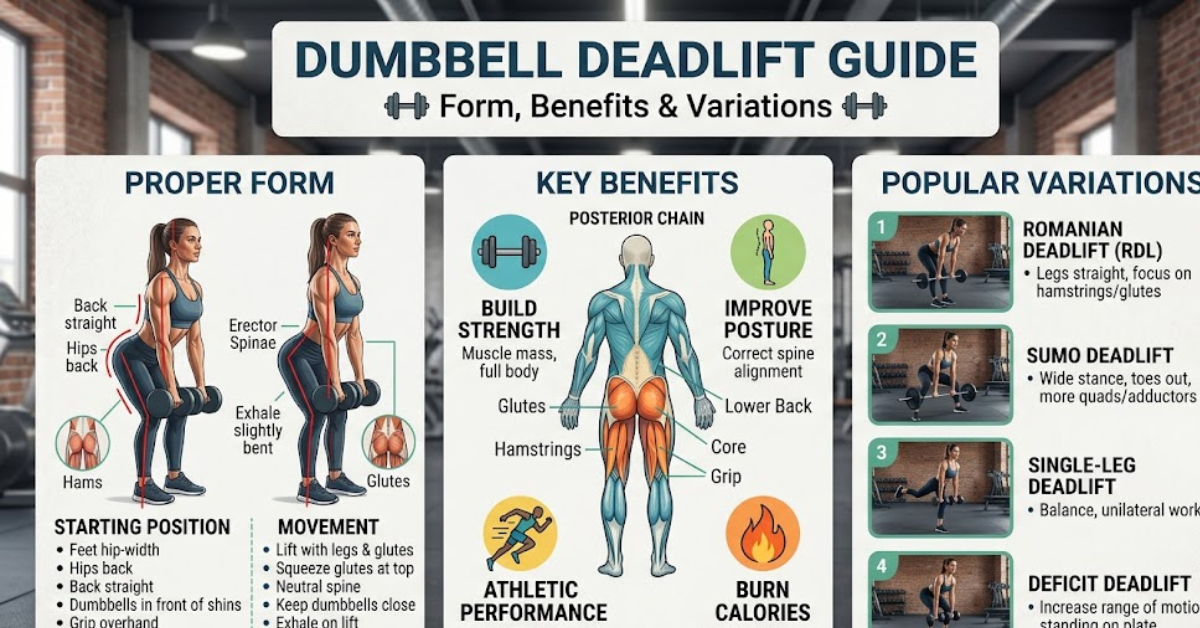
1. Builds Full-Body Strength
It targets multiple muscle groups at once, making workouts efficient and productive.
2. Improves Posture
Strengthening the back, glutes, and core helps support better alignment.
3. Beginner-Friendly
Many people find dumbbells less intimidating than barbells, making it easier to learn proper mechanics.
4. Enhances Athletic Power
Hip hinge strength carries over to sprinting, jumping, and lifting.
5. Great for Home Training
All you need is a pair of dumbbells and some floor space.
Dumbbell Deadlift Muscles Worked
This exercise trains several major muscles simultaneously.
Primary Muscles
- Glutes
- Hamstrings
- Quadriceps
- Erector spinae (lower back)
- Core stabilizers
Secondary Muscles
- Forearms
- Traps
- Lats
- Upper back
Because so many muscles are involved, the dumbbell deadlift is excellent for strength and calorie burn.
How to Master Dumbbell Deadlift Form
Technique matters more than load. Follow these steps:
- Stand with feet hip-width apart.
- Place dumbbells at your sides or in front of your legs.
- Brace your core and keep chest up.
- Push hips back while bending knees slightly.
- Lower weights close to your legs.
- Drive through your heels to stand tall.
- Squeeze glutes at the top without leaning backward.
Form Tips
- Keep spine neutral throughout
- Let hips lead the movement
- Keep dumbbells close to body
- Avoid rounding shoulders
- Move under control
Best Dumbbell Deadlift Variations
Changing the setup can target muscles differently and prevent plateaus.
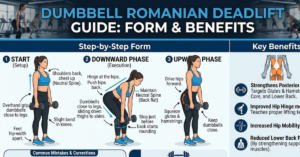
Romanian Dumbbell Deadlift
This version emphasizes hamstrings and glutes with minimal knee bend.
Best for: Posterior chain growth and hip hinge mechanics.
Stiff Leg Dumbbell Deadlift
Performed with straighter legs and strong hamstring stretch.
Best for: Flexibility and hamstring focus.
Single Leg Dumbbell Deadlift
Stand on one leg while hinging forward.
Best for: Balance, coordination, and unilateral strength.
Sumo Dumbbell Deadlift
Use a wide stance with toes slightly turned out.
Best for: Inner thighs, glutes, and upright torso positioning.
Single Dumbbell Deadlift
Hold one weight vertically between the legs.
Best for: Beginners and compact home workouts.
Dumbbell Deadlift to Row
Perform a hinge, then add a rowing motion before standing.
Best for: Combining back and lower-body training.
Dumbbell Deadlift vs Romanian Deadlift
Many people confuse these two movements, but they serve different purposes.
| Feature | Dumbbell Deadlift | Romanian Deadlift |
| Starting Position | Floor or low position | Standing |
| Knee Bend | Moderate | Slight |
| Main Focus | Full lower body | Hamstrings and glutes |
| Range of Motion | Larger | Controlled hinge |
| Best For | Strength and beginners | Posterior chain isolation |
If your goal is overall strength, choose standard deadlifts. If you want more hamstring tension, use the RDL.
Dumbbell Deadlift for Back Strength
While it’s mainly a lower-body lift, your back works hard to stabilize the spine and shoulders. Stronger spinal erectors, traps, and lats can improve posture and support safer lifting in daily life.
The key is maintaining a neutral spine rather than yanking the weight upward.
Common Dumbbell Deadlift Mistakes
Rounding the Lower Back
This often happens when weight is too heavy or hips drop poorly.
Squatting Instead of Hinging
The movement starts from the hips, not just the knees.
Letting Weights Drift Forward
Keep dumbbells close to reduce stress on the lower back.
Hyperextending at the Top
Stand tall, but don’t lean backward.
Moving Too Fast
Controlled reps build better technique and tension.
How to Program Dumbbell Deadlifts
Beginners
- 3 sets of 10 reps
Intermediate
- 4 sets of 8 reps
Advanced
- 4–5 sets of 5–8 reps with progressive overload
Use them early in your workout when energy is highest.
Who Should Do This Exercise?
The dumbbell deadlift works well for:
- Beginners learning hinge mechanics
- Home gym users
- Athletes wanting power and stability
- Lifters needing a lower-joint-stress alternative
- Anyone wanting stronger glutes and hamstrings
FAQ About Dumbbell Deadlift
What is a dumbbell deadlift?
It’s a strength exercise where you lift dumbbells using a hip hinge to train legs, glutes, back, and core.
Is a dumbbell deadlift effective?
Yes. It builds strength, muscle, and movement quality while requiring minimal equipment.
Can dumbbell deadlifts replace barbell deadlifts?
For many beginners and home trainees, yes. Advanced strength athletes may still benefit from barbells for maximum loading.
Which is better: dumbbell deadlift vs RDL?
Neither is universally better. Standard deadlifts train more total-body movement, while RDLs focus more on hamstrings and glutes.
Are dumbbell deadlifts safe for beginners?
Yes, when done with proper form and manageable weight.
How heavy should I go?
Use a weight that challenges you while allowing perfect posture and full control.
Conclusion
The dumbbell deadlift is one of the smartest exercises for building strength, muscle, and better movement patterns without complicated equipment. It trains the entire posterior chain, improves posture, and offers plenty of variations like the romanian dumbbell deadlift, sumo dumbbell deadlift, and single leg dumbbell deadlift.
Start light, focus on clean technique, and progress gradually. Once mastered, this exercise can become a cornerstone of your strength routine and help you perform better both in the gym and everyday life.