
If you want a stronger back, better posture, and more pulling power, the dumbbell row deserves a permanent place in your workout routine. It’s one of the most effective upper-body exercises for building thickness through the lats, rhomboids, traps, and rear shoulders while also improving grip and core stability.
Unlike machines, rows with free weights force your body to control the movement, helping correct strength imbalances and improve coordination. Whether you’re a beginner or experienced lifter, learning proper dumbbell row form can make a noticeable difference in both appearance and performance.
What Is a Dumbbell Row?
A dumbbell row is a pulling movement where you lift a dumbbell toward your torso while keeping your spine stable. The exercise mimics real-world pulling mechanics and trains the upper and mid-back muscles.
Because it can be done with one or two dumbbells, it offers flexibility for home gyms and commercial gyms alike.
Main Benefits
- Builds back thickness and width
- Strengthens posture muscles
- Improves grip strength
- Trains each side independently
- Supports better deadlifts and pull-ups
- Requires minimal equipment
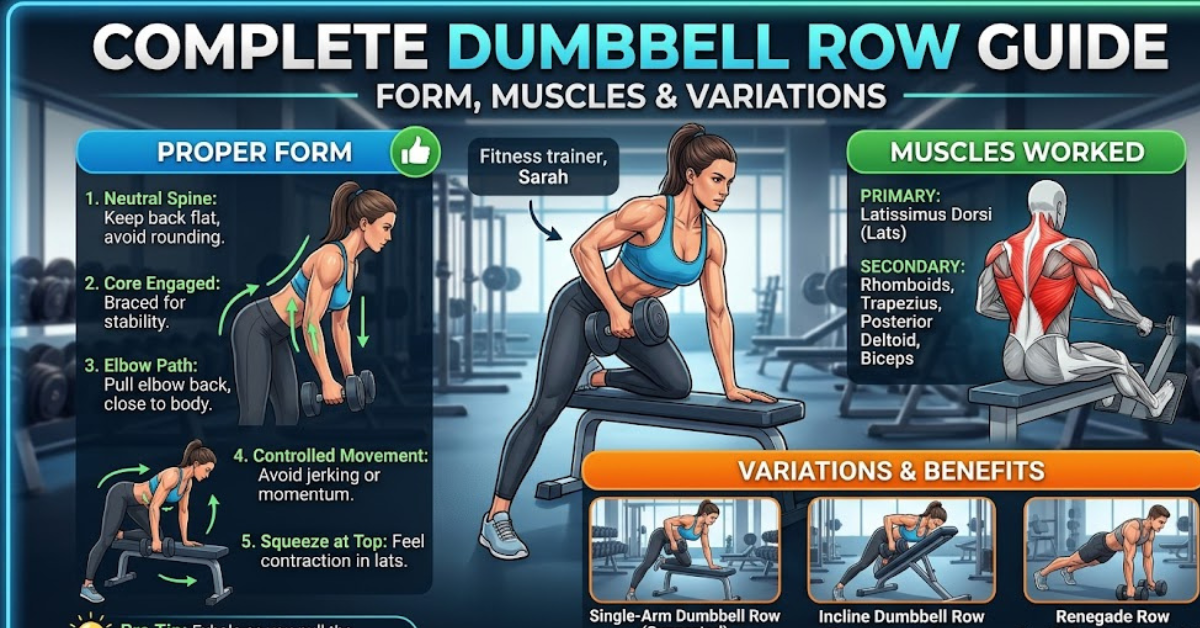
Dumbbell Row Muscles Worked
One reason this exercise is so popular is the number of muscles it targets.
Primary Muscles
- Latissimus dorsi (lats) – Adds width to the back
- Rhomboids – Pull shoulder blades together
- Trapezius – Supports upper-back strength
- Rear deltoids – Helps shoulder stability
Secondary Muscles
- Biceps
- Forearms
- Core muscles
- Lower back (for stabilization)
When performed correctly, the movement trains both strength and posture at the same time.
How to Do Proper Dumbbell Row Form
Good technique matters more than heavy weight. Follow these steps:
Single Arm Dumbbell Row
- Place one knee and one hand on a bench.
- Keep your back flat and chest open.
- Hold the dumbbell in the free hand.
- Pull the weight toward your hip, not your shoulder.
- Squeeze your shoulder blade at the top.
- Lower slowly under control.
- Repeat on both sides.
Key Form Tips
- Keep your neck neutral
- Avoid twisting your torso
- Pull with the elbow, not the hand
- Use full range of motion
- Control the lowering phase
Best Dumbbell Row Variations
Different setups target the back from unique angles and help prevent plateaus.
1. Bent Over Dumbbell Row
Stand hinged at the hips with a dumbbell in each hand and row both weights upward.
Best for: Overall back mass and strength.
2. Single Arm Dumbbell Row Bench
Using a bench gives extra support and lets you focus on one side at a time.
Best for: Fixing imbalances and improving mind-muscle connection.
3. Chest Supported Dumbbell Row
Lie face down on an incline bench and row both weights.
Best for: Reducing lower-back strain and isolating upper-back muscles.
4. Incline Dumbbell Row
Performed on a slight incline bench angle for a strict pulling path.
Best for: Controlled hypertrophy training.
5. Standing Dumbbell Row
Done without a bench while hinged forward.
Best for: Home workouts and adding core involvement.
6. Reverse Grip Dumbbell Row
Use palms-up grip to involve more biceps and lower lats.
Best for: Variety and arm-back combination work.
7. Upright Dumbbell Row
Lift dumbbells upward along the body toward chest height.
Best for: Traps and shoulders rather than traditional back rowing.
Common Dumbbell Row Mistakes
Avoid these issues if you want better results and fewer injuries.
1. Rounding the Back
Keep your chest proud and spine neutral.
2. Using Momentum
Swinging the weight reduces muscle tension.
3. Pulling Too High
Row toward the hip or lower ribs, not the neck.
4. Twisting the Body
Keep hips square and stable.
5. Going Too Heavy Too Soon
Master movement quality first.
Dumbbell Row vs Barbell Row
| Feature | Dumbbell Row | Barbell Row |
| Range of Motion | Greater | Moderate |
| Unilateral Training | Yes | No |
| Lower Back Stress | Lower (supported versions) | Higher |
| Home Gym Friendly | Excellent | Good |
| Load Potential | Moderate | High |
For many people, dumbbells are easier on the joints and better for balanced development.
Dumbbell Row Alternative Exercises
Need variety or no dumbbells available? Try these:
- Seated cable row
- Resistance band row
- Inverted row
- Barbell row
- T-bar row
- Machine row
These options train similar pulling muscles with different resistance profiles.
How to Program Dumbbell Rows
For muscle growth and strength, include rows 1–3 times weekly.
Beginners
- 3 sets of 10–12 reps
Intermediate
- 4 sets of 8–10 reps
Advanced
- 4–5 sets of 6–12 reps with progressive overload
Pair rows with presses, pull-ups, and shoulder work for a balanced upper-body routine.
Can Beginners Do Dumbbell Rows?
Absolutely. This movement is beginner-friendly because it teaches pulling mechanics safely. Start with light weight and prioritize control.
Using a bench-supported setup often makes learning easier than unsupported rows.
FAQ About Dumbbell Row
What muscles does a dumbbell row work?
Mainly the lats, rhomboids, traps, rear delts, biceps, and core stabilizers.
Is a single arm dumbbell row better than two-arm rows?
Neither is better universally. One-arm versions improve balance and isolation, while two-arm rows save time and allow heavier loading.
How heavy should I go?
Choose a weight that challenges you while allowing perfect form for your target reps.
Are chest-supported rows good?
Yes. They reduce lower-back fatigue and help isolate the upper back.
Can I do dumbbell rows every day?
Daily heavy rows are not ideal. Muscles need recovery. Two to three weekly sessions is more effective.
What is the best dumbbell row alternative?
Cable rows and inverted rows are excellent substitutes depending on equipment access.
Conclusion
The dumbbell row is one of the smartest exercises for building a stronger, thicker, healthier back. It trains multiple muscles, improves posture, and fits nearly any workout plan. Whether you prefer the bent over dumbbell row, one arm dumbbell row, or chest-supported dumbbell row, the key is consistent effort and solid technique.
Start light, master your form, and progress over time. Add this movement to your routine and you’ll quickly notice stronger pulls, better posture, and a more athletic upper body.